The petrochemical industry is one of the most important industrial sectors in the world and involves the production of chemicals and materials based on fossil raw materials such as crude oil and natural gas. Its production processes generate a variety of different wastewater and require specialized solutions in water treatment and wastewater treatment. This article describes the water technology challenges of the petrochemical industry in detail, focusing on chemical-technical processes, environmental aspects and practice-oriented solutions.
Table of contents
Importance of the petrochemical industry
The petrochemical industry is central to the production of plastics, solvents, surfactants, pharmaceuticals, dyes and many other products. At the same time, it is one of the largest consumers of fresh water and produces highly contaminated wastewater, which poses a particular challenge for water treatment due to its complex ingredients and high concentrations of pollutants.
Water consumption in the petrochemical industry
Process water:
- Used in chemical reactions and for the purification of raw materials and products.
- Requirements: High purity, free of suspended solids and dissolved salts.
Cooling water:
- Large quantities of water are used in cooling systems to reduce heat.
- Challenge: Avoiding biofouling, corrosion and scaling.
Steam generation:
- Use of water to generate high-pressure steam, which is required in production processes and power plants.
- Requirements: Low salt content to avoid deposits in boilers.
Waste water in the petrochemical industry
Wastewater from the petrochemical industry is characterized by its high complexity and variability. They often contain a mixture of organic and inorganic compounds, which are present in varying concentrations.
Typical ingredients of petrochemical wastewater:
Hydrocarbons:
- Aromatics (e.g. benzene, toluene, xylene - BTX), aliphatics and polycyclic aromatic hydrocarbons (PAHs).
- Properties: Hydrophobic, often toxic and poorly biodegradable.
Poorly degradable organic compounds:
- Halogenated compounds, phenols and organic acids.
- Challenge: Persistence and potential toxicity.
Suspended solids and emulsions:
- Oil-water emulsions and undissolved solids that have to be separated mechanically.
Inorganic compounds:
- Sulphates, chlorides, metals and phosphates.
- Properties: Can cause corrosion or form deposits.
COD/BOD values:
- Wastewater often has high concentrations of chemical oxygen demand (COD) and biochemical oxygen demand (BOD), which requires sophisticated treatment.
Challenges in water and wastewater treatment
High concentrations of pollutants:
- Petrochemical wastewater often contains toxic substances that can impair the efficiency of biological treatment processes.
Fluctuating wastewater composition:
- Varying production processes lead to uneven wastewater volumes and compositions.
Legal requirements:
- Strict limits for hydrocarbons, heavy metals and other pollutants in waste water and emissions must be complied with.
Cost and resource efficiency:
- High water consumption and energy costs call for innovative and sustainable solutions.
Processes for water and wastewater treatment in the petrochemical industry
Petrochemical wastewater is treated in several stages that combine physical, chemical and biological processes.
1. mechanical pre-treatment
Purpose:
Mechanical pre-treatment is used to remove coarse solids, oil droplets and emulsions in order to reduce the load on subsequent treatment stages and increase their efficiency.
Typical processes:
Sand trap:
- Separation of suspended solids such as sand and mineral particles that collect at the bottom of the sedimentation tank.
- Application: Pre-treatment of heavily contaminated wastewater with a high solids content, e.g. in refineries.
Oil separator (API separator):
- Separation of the oil and water phases based on density differences.
- API separators (American Petroleum Institute) are standard systems for removing free oil (>150 µm) and coarse particles.
- Application: Treatment of waste water containing oil, e.g. from crude oil processing.
- Effective removal of finely dispersed oil droplets and emulsified contaminants that cannot be captured by conventional separators.
- In dissolved air flotation plants (DAF) air is injected into the wastewater under pressure. When the pressure is released, fine air bubbles are formed which transport particles and oil droplets to the surface.
- Chemical support: Use of flocculants to agglomerate the finest particles.
- Application: Waste water from distillation, cracking processes or storage of oil products.
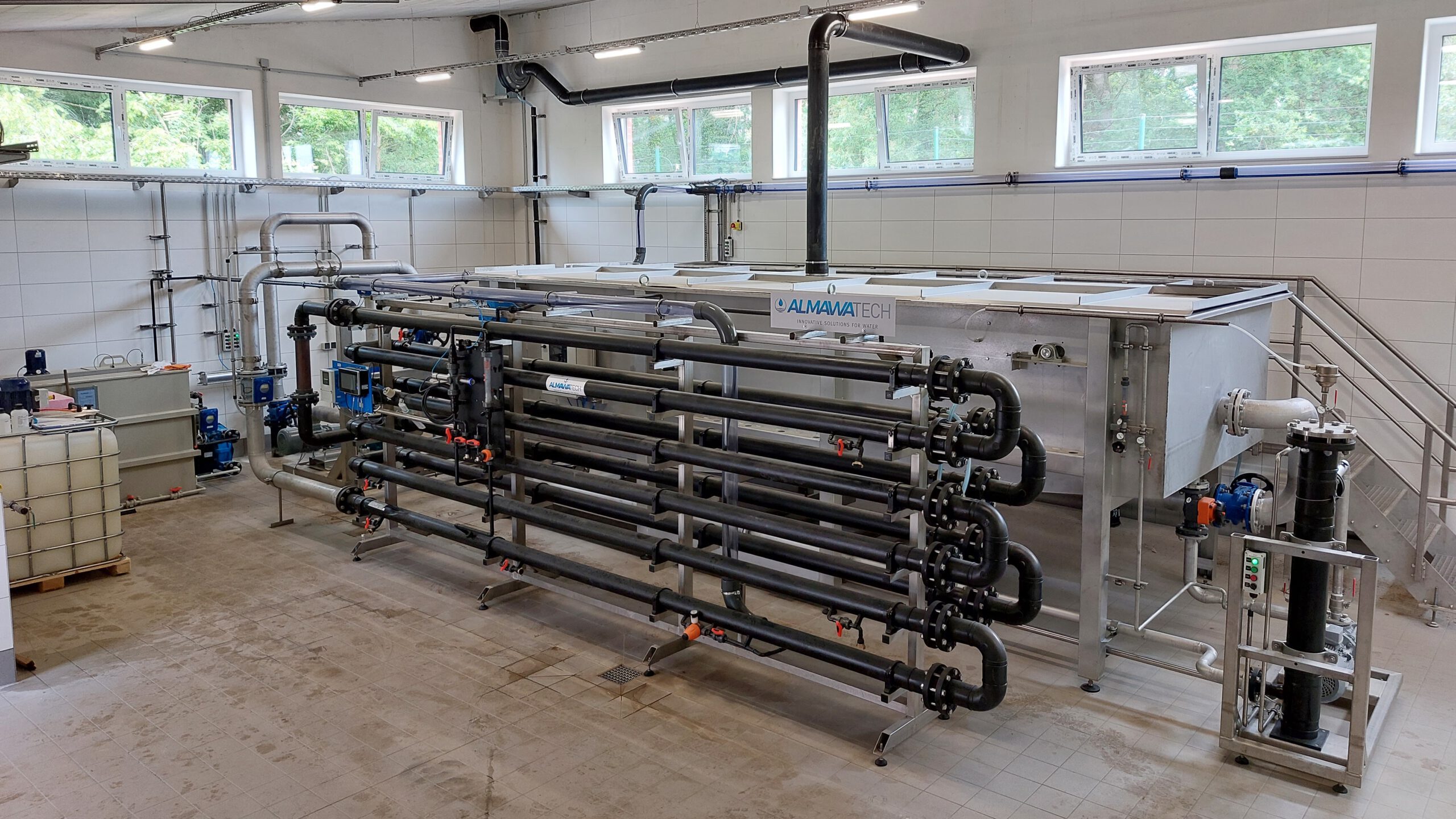
Photo: Our ALMA NeoDAF flotation system with load-proportional dosing of precipitants and flocculants
2. chemical-physical treatment
Purpose:
Chemical-physical treatment aims to remove dissolved pollutants, stabilize the composition of wastewater and reduce compounds that are difficult to break down.
Typical processes:
Precipitation and flocculation:
- Removal of heavy metals, phosphates and colloidal impurities by adding precipitants (e.g. iron or aluminum salts) and flocculants (e.g. polyelectrolytes).
- Formation of larger flakes that can be easily removed by sedimentation or flotation.
- Application: Reduction of heavy metals and turbidity in waste water from petrochemical processes.
- Adjustment of the pH value by adding acids (e.g. sulphuric acid) or alkalis (e.g. sodium hydroxide) to create optimum conditions for precipitation or biological processes.
- Application: Neutralization of acidic or alkaline process wastewater.
Adsorption using activated carbon:
- Removal of organic pollutants by binding to adsorbents such as activated carbon.
- Application: Removal of phenols, BTX (benzene, toluene, xylene) and PAHs.
- Decomposition of poorly degradable organic compounds through the use of oxidizing agents such as ozone, hydrogen peroxide or chlorine.
- Advanced Oxidation Processes (AOPs)Combination of oxidizing agents with UV light or catalysts to generate reactive hydroxyl radicals.
- Application: Treatment of aromatic hydrocarbons and halogenated compounds.

Photo: Our CP system ALMA CHEM MCW with neutralization and downstream activated carbon filter
3. biological treatment
Purpose:
Biological treatment uses microorganisms to break down organic compounds and reduce COD pollution.
Typical procedures:
- Aerobic degradation of organic substances by microorganisms in an oxygen-rich reactor.
- Suitable for readily biodegradable organic compounds.
- Application: Wastewater from the storage and processing of oil products.
- Decomposition of organic substances under oxygen-free conditions, producing methane and CO₂ as biogas.
- Typical reactors: UASB (Upflow Anaerobic Sludge Blanket) and EGSB (Expanded Granular Sludge Bed).
- Application: Wastewater with a high organic load, e.g. from cracking and polymerization processes.
- Combination of biodegradation and membrane filtration for the separation of biomass and residual pollutants.
- Advantage: High efficiency and space-saving design.
- Application: High-purity waste water, e.g. for recycling processes.
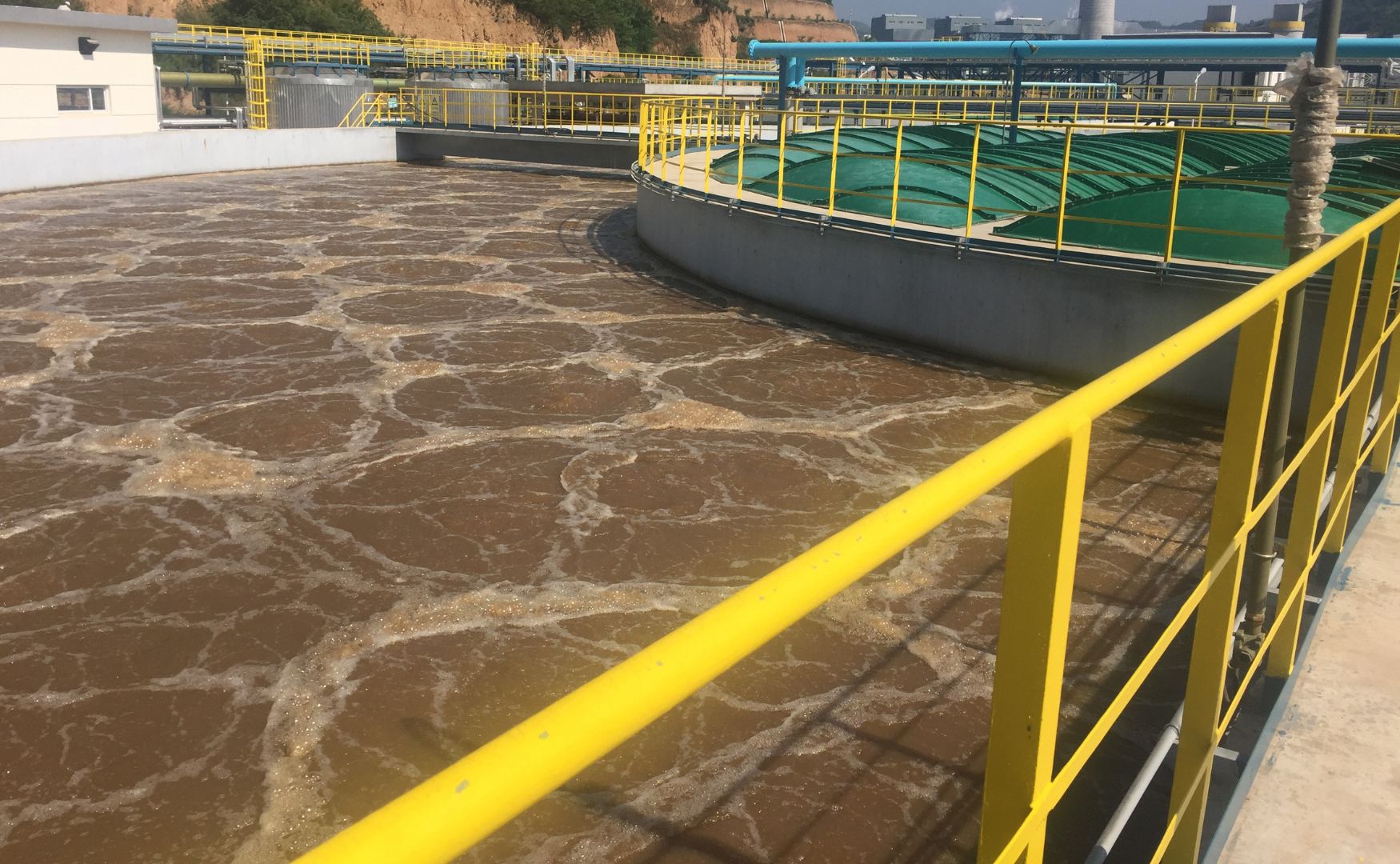
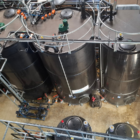
Photo: Our aeration tank of the ALMA BHU BIO system, for treating wastewater from a refinery
4. tertiary treatment and follow-up treatment
Purpose:
Removal of residual pollutants, salts and germs to ensure compliance with strict limit values.
Typical procedures:
- Removal of dissolved salts, heavy metals and organic residues using semi-permeable membranes.
- Application: Recycling of water and compliance with discharge standards.
- Removal of specific ions such as chloride, sulphate or heavy metals.
- Application: Post-treatment for reuse as process water.
Disinfection:
- Destruction of germs and microorganisms by UV light, ozonation or chlorination.
- Application: Discharge of wastewater into public waters or return to the production cycle.
Legal limits and environmental regulations
The petrochemical industry is subject to strict environmental regulations set by international and national organizations. Typical limit values are
- Kohlenwasserstoffe (gesamt): < 10 mg/L (Einleitung in Oberflächengewässer, je nach Region).
- CSB: < 125 mg/L (Einleitung in Oberflächengewässer gemäß EU-Wasserrahmenrichtlinie).
- Schwermetalle (z. B. Hg, Pb, Cd): < 0,1–1 µg/L, abhängig vom Metall und Einsatzgebiet.
Conclusion
Water and wastewater treatment in the petrochemical industry places high demands on technology and process management. Due to the complex composition of the wastewater and the strict environmental regulations, customized solutions are required that efficiently combine physical, chemical and biological processes.
For further information on our products, please feel free to contact us at any time!