
ALMA AQUA sludge conditioning
We would be happy to support you with the professional conditioning of your wastewater sludge!

Frank Kuntze
Sales Manager Water and Process Additives
Why the right choice is crucial
Proof of Performance - Our references





Your benefits with ALMA AQUA sludge conditioning
Service & technology - everything from a single source
Advice & system recording
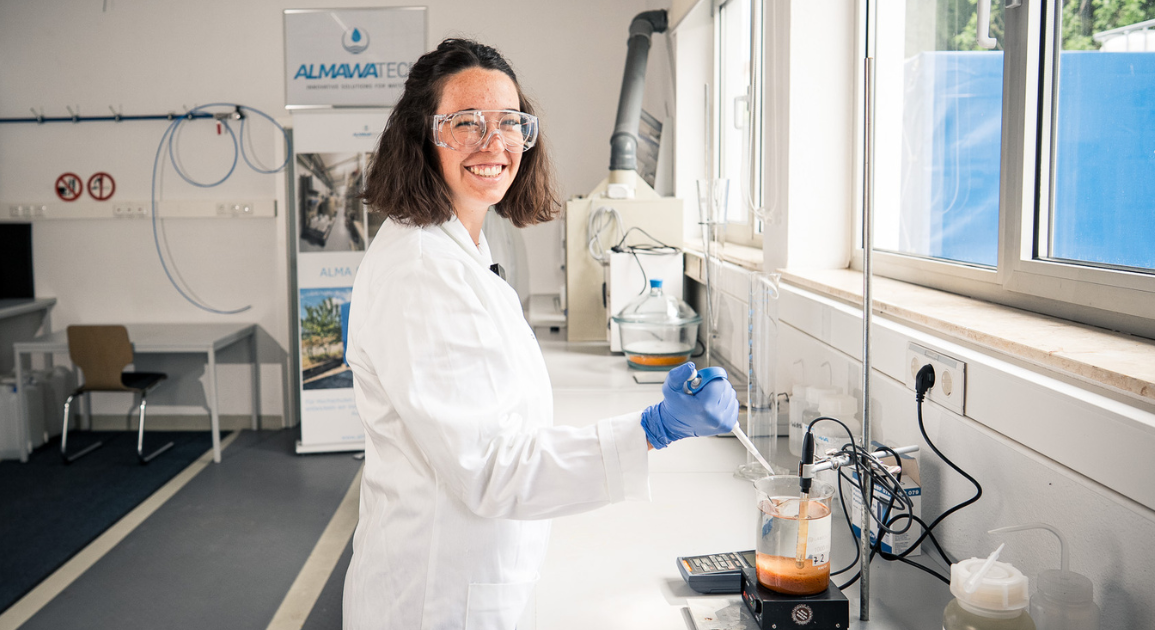
Laboratory and practical tests
Online monitoring & software solutions
Integrated dosing and control technology
Automated additive replenishment
Evaluation & reporting
Formulations & compatibility
OEM & private label solutions
FAQ
What is sludge conditioning and why is it so important?
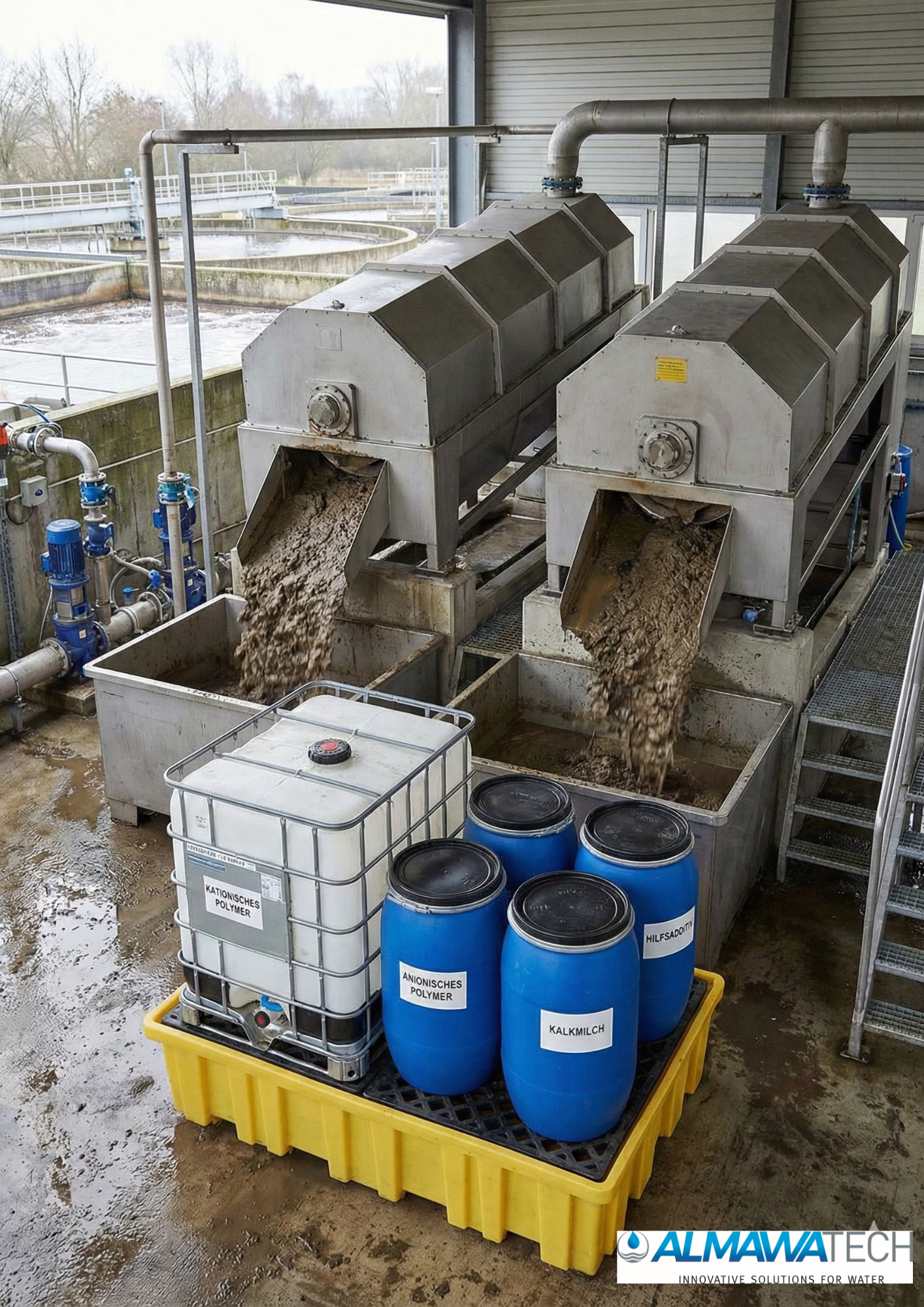
Sludge conditioning is the targeted chemical treatment of sludge before it is dewatered in mechanical dewatering systems such as chamber filter presses, belt filter presses, centrifuges or sieve drums. The aim is to change the physical properties of the sludge so that it releases water more easily and can be processed mechanically more efficiently.
Polymers or other additives are used to combine the fine particles into larger, stable flocs. This reduces the residual water content (increases the dry residue, TS) and ensures uniform filter cake formation.
Without effective sludge conditioning, typical problems arise:
High water content in the sludge → High disposal and transportation costs
Unstable dewatering results → fluctuating TS values
Mechanical problems in the drainage → Blockage, filter breakthroughs
Increased energy consumption due to longer dewatering cycles
In short: sludge conditioning determines the costs, operational safety and environmental compliance of a plant.
What problems arise if the sludge is not properly conditioned?
Unsuitable conditioning - whether due to incorrect product selection, an unsuitable dosing strategy or a lack of adaptation to the sludge - leads to a chain reaction of operating problems:
High residual water content: Every percentage point less dry matter can result in thousands of euros in additional costs for disposal and transportation per year.
Unstable filter cake structure: flocs disintegrate, filtrate becomes cloudy, filter cloths clog more quickly.
Excessive polymer consumption: Incorrect charge density or molecular weights lead to overdosing without any increase in performance.
Clogged filter media: Fine particles or biofilms block filter pores, which increases cleaning effort and downtimes.
Fluctuating results with changing feed composition, e.g. seasonal changes or production changes.
Consequential damage: Higher loads in downstream processes, e.g. due to insufficiently separated solids in the filtrate.
These problems quickly add up to considerable additional costs and reduced system availability.
How do I find the right conditioning agent for my system?
At ALMA AQUA, selection is systematic and data-based - not random or based on standard lists. Our approach:
Analysis of the sludge characteristics
DM content, particle size distribution, organic/inorganic content
Surface charge (zeta potential) to determine the optimum polymer charge
Influencing factors such as pH value, temperature, salt content
Laboratory tests (Jar Tests)
Simulation of conditioning with different polymer types (anionic, cationic, non-ionic) and molecular weights
Observation of floc formation, filterability, dewatering speed
On-site tests in real operation
Optimization of dosing quantity, activation time, mixing intensity
Testing of different dosing points (before/middle/after precipitation)
Long-term evaluation
Documentation of TS values, polymer consumption, dewatering performance
Adjustment of the parameters in the event of changed inlet conditions
The result: a customized conditioning concept that reduces costs, increases dewatering performance and ensures process stability.
What are the advantages of ALMA AQUA sludge conditioning?
Our products and processes offer more than just "better flocs" - they are an overall concept for optimizing sludge treatment.
Direct operational benefits:
Higher dry residue (TS) → less water, lower disposal costs
Stable filter cake structure → consistent quality, less downtime
Reduced chemical consumption through targeted dosing and suitable product selection
Better filtrate quality → Lower load on downstream stages
Longer service life of filter cloths, belts and centrifuge components
Technical advantages through our approach:
Tailor-made product selection based on laboratory and practical tests
Perfect coordination with existing precipitants and process additives
Adaptability with fluctuating sludge composition
Integration into automated dosing and monitoring systems
Additional benefits:
Reduced energy costs due to shorter dewatering cycles
Compliance with legal requirements through stable process management
Personal support from experienced ALMA AQUA process engineers
What product forms are available for sludge conditioning agents?
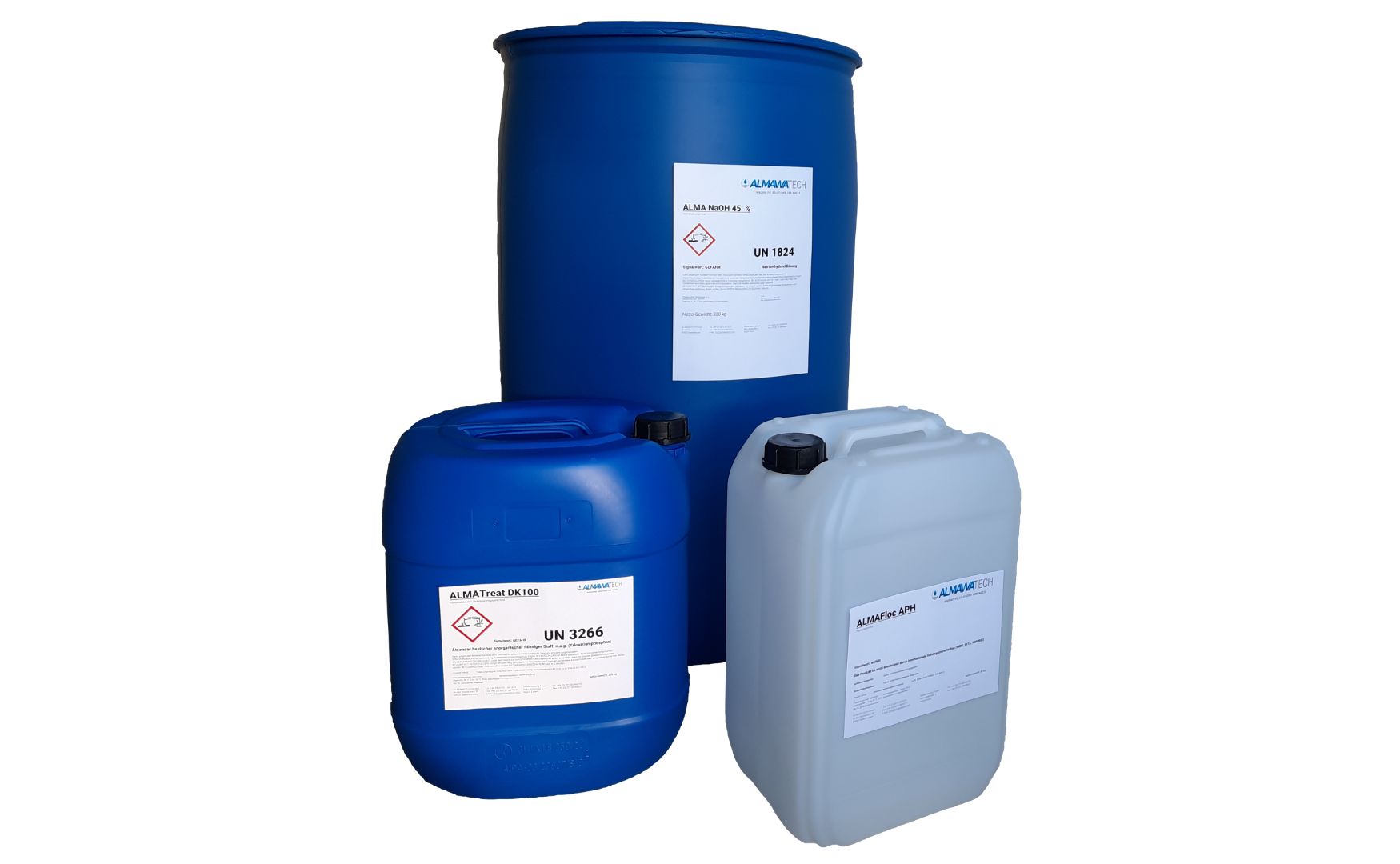
ALMA AQUA offers conditioning agents in three main forms - each with specific advantages, tailored to consumption quantity, storage logistics and dosing technology:
Powder products
Highly concentrated (up to 100 % active ingredient content) → Very economical to transport and store
Long storage stability (up to 2 years) when stored in a dry place
Ideal for large drainage systems with continuous operation
Requires a polymer preparation station for dissolution and activation before dosing
Emulsion products
Already contain partially dissolved polymer in oil phase → fast solubility in water
Less activation time than powder
Simple integration into existing dosing pump systems
Well suited for medium to high consumption and systems with frequent start-ups and shutdowns
Ready-to-use solutions
Can be dosed directly, without further preparation
Minimizes operating errors and is particularly suitable for small systems or pilot tests
Ideal for customers who do not want to install their own attachment technology
All product forms are available in flexible container sizes (canisters, drums, IBCs, big bags) and can be adapted to the requirements of your logistics and dosing technology.
Do you offer support in optimizing drainage?
Yes - and not just as a one-off consultation, but as a complete optimization process.
Our technical support includes:
Laboratory analyses & jar tests to select the optimum polymer and dosing parameters
On-site optimization of your dewatering system - adjustment of dosing points, mixing intensity, activation time
Real-time data acquisition of dry matter content, polymer consumption and filtrate quality
Integration into automation systems - from simple dosing pumps to fully automatic dosing stations with online monitoring
Training of operating personnel to avoid operating errors and ensure long-term efficiency
Long-term monitoring with regular evaluations, suggestions for optimization and adaptation to changing sludge compositions
Goal: Maximum drainage performance at minimum cost - permanently.
How does the sludge composition affect the conditioning?
The condition of the sludge is one of the decisive factors for the selection and effectiveness of a conditioning agent:
Biological sludge (e.g. from activated sludge processes)
Contain many organic substances and bacterial extracellular substances that bind water
Often require cationic polymers with higher charge density to break this bond
Chemically precipitated sludge (e.g. from precipitation/flocculation plants)
Mostly mineral, often denser and heavier
React well to anionic or non-ionic polymers
Mixed sludge
Combination of organic and inorganic components
Often require special combination formulations or graduated dosing strategies
The pH value, salt content, temperature and particle size also influence the effectiveness. We therefore always carry out laboratory and practical tests before making a recommendation.
How can the right conditioning extend the service life of dewatering machines?
Optimum conditioning protects the mechanics and filter media of your dewatering system:
Stable flocs → fewer fine particles in the filtrate, resulting in less abrasion on filter cloths, sieves or centrifuge components
Uniform filter cake formation → fewer punctual loads, no "hotspots" with premature wear
Fewer cleaning cycles → less stress due to high-pressure cleaning, extended service life of the filter media
Constant operation → fewer unplanned shutdowns due to blockages or overflows
In practice, this allows us to extend the service life of filter cloths by up to 50 % and reduce cleaning intervals at the same time.
What role does the activation time of the polymer play in sludge conditioning?
The activation time is the time a polymer needs to fully unfold in the water and develop its full flocculation effect.
Activation time too short → Polymer chains are not yet completely dissolved, floc formation remains incomplete, more residual water in the sludge
Activation time too long → Polymer chains can be mechanically damaged or partially degraded, effectiveness decreases
Optimal activation time → depending on product type, concentration, water temperature and stirring intensity
We determine this value in the laboratory and in practice and then adjust the polymer preparation station and the dosing system so that the product enters the process in exactly the right state.
This saves up to 20 % polymer consumption and ensures maximum dewatering efficiency.
Need technical advice? Inquire now!
Frank Kuntze
Sales Manager Water and Process Additives