
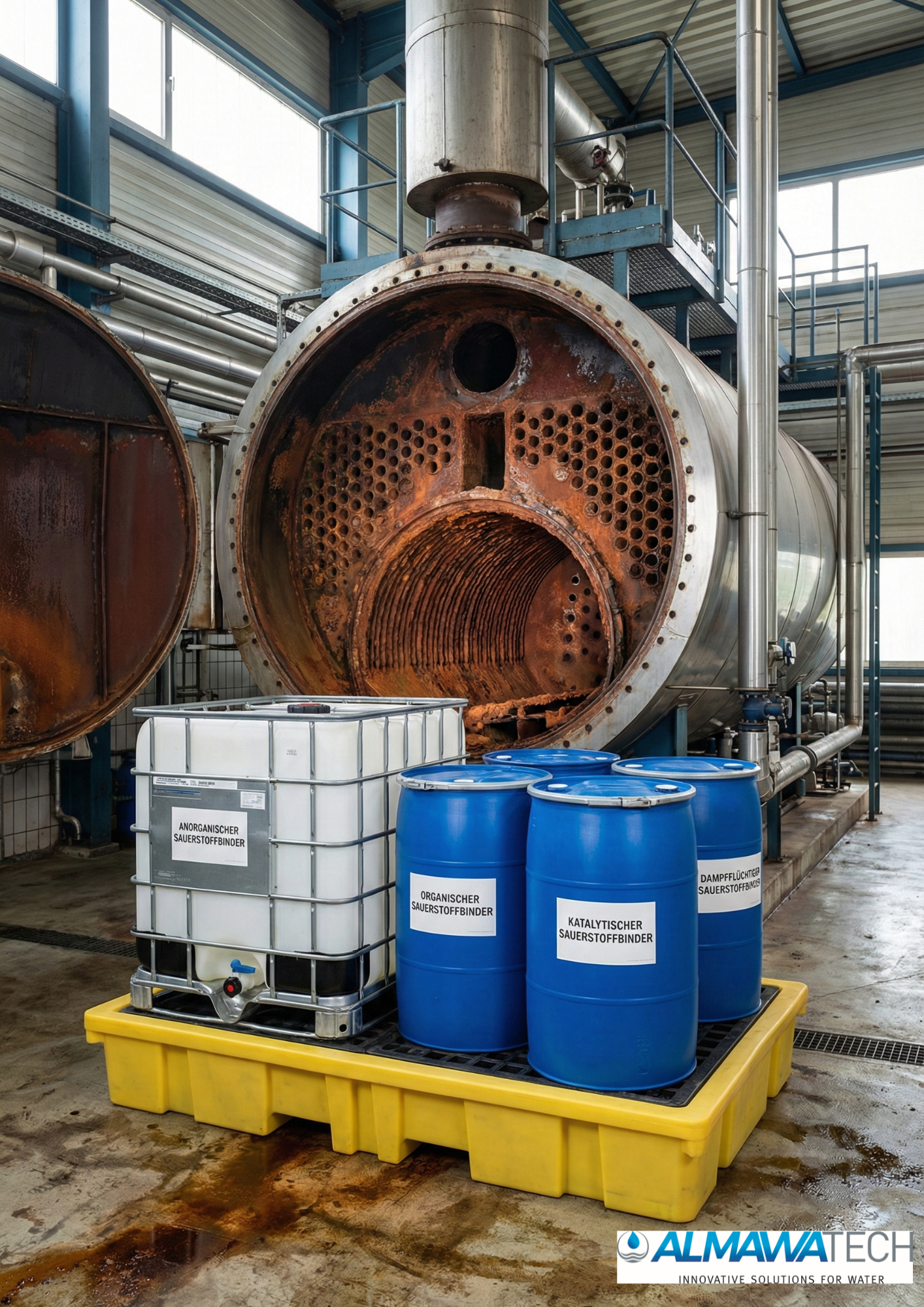
Oxygen binders and reducing agents
Corrosion problems due to dissolved oxygen? We can help!

Frank Kuntze
Sales Manager Water and Process Additives
Why oxygen binders are indispensable
Proof of Performance - Our references





Your benefits with ALMA AQUA oxygen binders
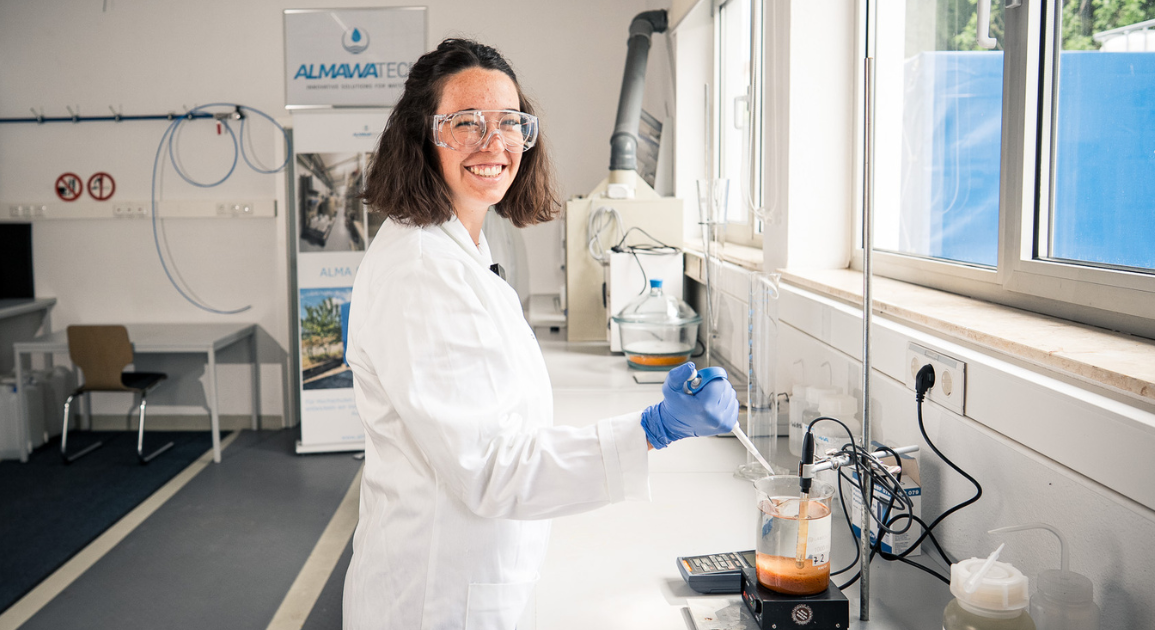
Service & technology - everything from a single source
Advice & system recording
Analytics & field tests
Online monitoring & software solutions
Integrated dosing and control technology
Automated additive replenishment
Evaluation & reporting
Formulations & compatibility
OEM & private label solutions
FAQ
What are oxygen binders used for in water systems?
Sauerstoffbinder (Reduktionsmittel) dienen der gezielten Entfernung von gelöstem Sauerstoff (O₂) aus Wasser, um Korrosion an metallischen Werkstoffen zu verhindern. Bereits geringe Konzentrationen von <0,1 mg/l O₂ reichen aus, um Lochfraß, Magnetitbildung und Materialzersetzung zu verursachen – vor allem in Heißwasser- und Dampfanlagen, wo Temperatur und Druck die Reaktionsgeschwindigkeit erhöhen.
Oxygen binders work chemically by converting O₂ into harmless reaction products (e.g. sulphate). The result: corrosion protection, lower maintenance costs and standard-compliant operation - especially in boiler systems, district heating systems or feed water treatment systems.
Which active ingredients are used in ALMA AQUA?
Depending on the application, temperature, material and regulatory requirements, we use the following active ingredients, among others:
Sodium sulphite / sodium hydrogen sulphite - proven, fast-acting at temperatures >60 °C
DEHA (diethylhydroxylamine) - volatile, ideal for steam circuits, also protects condensate lines
Hydrazine - very reactive, but toxic - only in exceptional cases, e.g. in high-pressure boilers
Carbohydrazide - non-toxic hydrazine alternative with a similar effect
Erythorbic acid / ascorbic acid - biodegradable, particularly suitable for food & pharmaceuticals
We provide individual advice on the selection of the right active ingredient, taking into account environmental regulations, material compatibility and standards such as VDI 2035 or PED.
How quickly do oxygen binders work?
The reaction speed depends on the active ingredient, the temperature, the pH value and the mixing intensity. Sulphite-based products typically act very quickly from approx. 60 °C, while DEHA and carbohydrazide are also active in low temperature ranges, but require a longer contact time.
Volatile components such as DEHA have an additional effect in the steam area, where they also protect the condensate network from corrosion via condensation. Good mixing and precise dosing are crucial for rapid action - ideally monitored via online oxygen measurement.
In which systems are oxygen binders used?
Our oxygen binders are used in many industrial and commercial applications, e.g:
Boiler systems (steam and hot water boilers)
District heating networks & local heating systems
Hot water storage tank and large water heater
Feed water and condensate treatment
Pure and process water systems with O₂-sensitive chemistry
Cold water systems with O₂ diffusion via plastic pipes
Oxygen is particularly critical in closed systems with steel, cast iron or copper components - here oxygen binding effectively protects against micro- and contact corrosion.
How are oxygen binders dosed?
The dosage depends on:
O₂ content in the raw or feed water
System size and operating volume
Temperature and flow conditions
Consumption through chemical reactions (e.g. with iron)
Typische Zielwerte für Kesselanlagen: <0,02 mg/l gelöster Sauerstoff. Die Dosierung erfolgt meist kontinuierlich, z. B. über Dosierpumpen in den Speisewassertank oder Vorlauf. Bei flüchtigen Produkten wie DEHA wird zusätzlich die Dampfverteilung berücksichtigt.
Our specialist consultants will prepare an exact dosing calculation and supply an automated dosing and monitoring unit on request.
Are your products compatible with other additives?
Yes - our oxygen binders are fully compatible with:
pH stabilizers & alkalizing agents
Corrosion inhibitors (e.g. molybdates, phosphates, amines)
Antiscalants & hardness stabilizers
Dispersants & cleaning chemicals
For steam systems, we pay particular attention to compatibility with volatile components in order to ensure steam quality, condensate flow and material protection. In sensitive systems, we test the interactions in the laboratory or directly in trial operation.
What regulatory requirements do I have to observe (e.g. VDI 2035, PED)?
The use of oxygen binders is subject to various technical regulations and legal requirements:
VDI 2035 Blatt 1 & 2: Definiert zulässige O₂-Konzentrationen in Heiz- und Kesselwasser. Zielwert: <0,02 mg/l
PED (Pressure Equipment Directive): Relevance for material selection & mode of operation for boiler systems
Drinking water ordinance / BfR: Only tested active substances may be used for systems that come into contact with drinking water (e.g. storage tank charging systems)
TA Luft / WHG: Specifications for the disposal of conditioned water - especially for products containing sulphite
Our products meet these requirements. We support you with:
Safety data sheets
Regulatory references & test certificates
Protocols for standard-compliant application
Are there also environmentally friendly or food-safe variants?
Yes, we offer alternative oxygen binders that:
Biodegradable (e.g. erythorbic acid)
hydrazine-free / heavy metal-free
DVGW or FDA/BfR compliant
AOX-free and non-toxic for aquatic systems are
These products are ideal for food processing plants, pharmaceutical applications, sensitive district heating systems or systems with high environmental and occupational safety standards. They offer good oxygen binding with minimal residual contamination in waste water.
How can I tell if I need an oxygen binder?
There is always a need for oxygen binders when free, dissolved oxygen (O₂) is present in the water - particularly critical in:
Boiler systems & steam systems
District heating and hot water circuits
Feed water treatment & condensate return
Pure water/VE systems with O₂ input through aeration or diffusion
Typical signs of insufficient oxygen protection are
Corrosion damage to steel or copper pipes (pitting, magnetite, rust)
Noticeable iron concentrations in the water (>0.3 mg/l)
Oxygen input via plastic pipes or open storage tanks
Incomplete or fluctuating pressure maintenance conditions
Visible deposits in boilers, heat exchangers or containers
The most reliable method of detection is to measure oxygen in the water - either in the laboratory or online using optoelectronic sensors (e.g. with luminescence technology).
If the O₂ content is >0.02 mg/l (boiler water) or >0.1 mg/l (heating or district heating systems), the use of a suitable oxygen binder is strongly recommended - in accordance with VDI 2035, PED and manufacturer specifications.
We offer:
Water analysis & SI/O₂ measurement
System check for diffusion sources and return issues
Recommendation and integration of suitable oxygen binders + technology
Need technical advice? Inquire now!
Frank Kuntze
Sales Manager Water and Process Additives