
Efficient chemical water treatment
Contact our experts for individual advice on your chemical water treatment system!

Frank Kuntze
Sales Manager Water and Process Additives
Objectives of chemical wastewater treatment

Proof of Performance - Our references





Your advantages with ALMA AQUA
Standards and guidelines
Process additives & service - everything from a single source
Advice & system recording
Target definition
Product recommendation & treatment concept
Dosing and monitoring concept
Sampling & detection
Evaluation & reporting
FAQ
How do precipitants, neutralizing agents and flocculants work in chemical wastewater treatment?
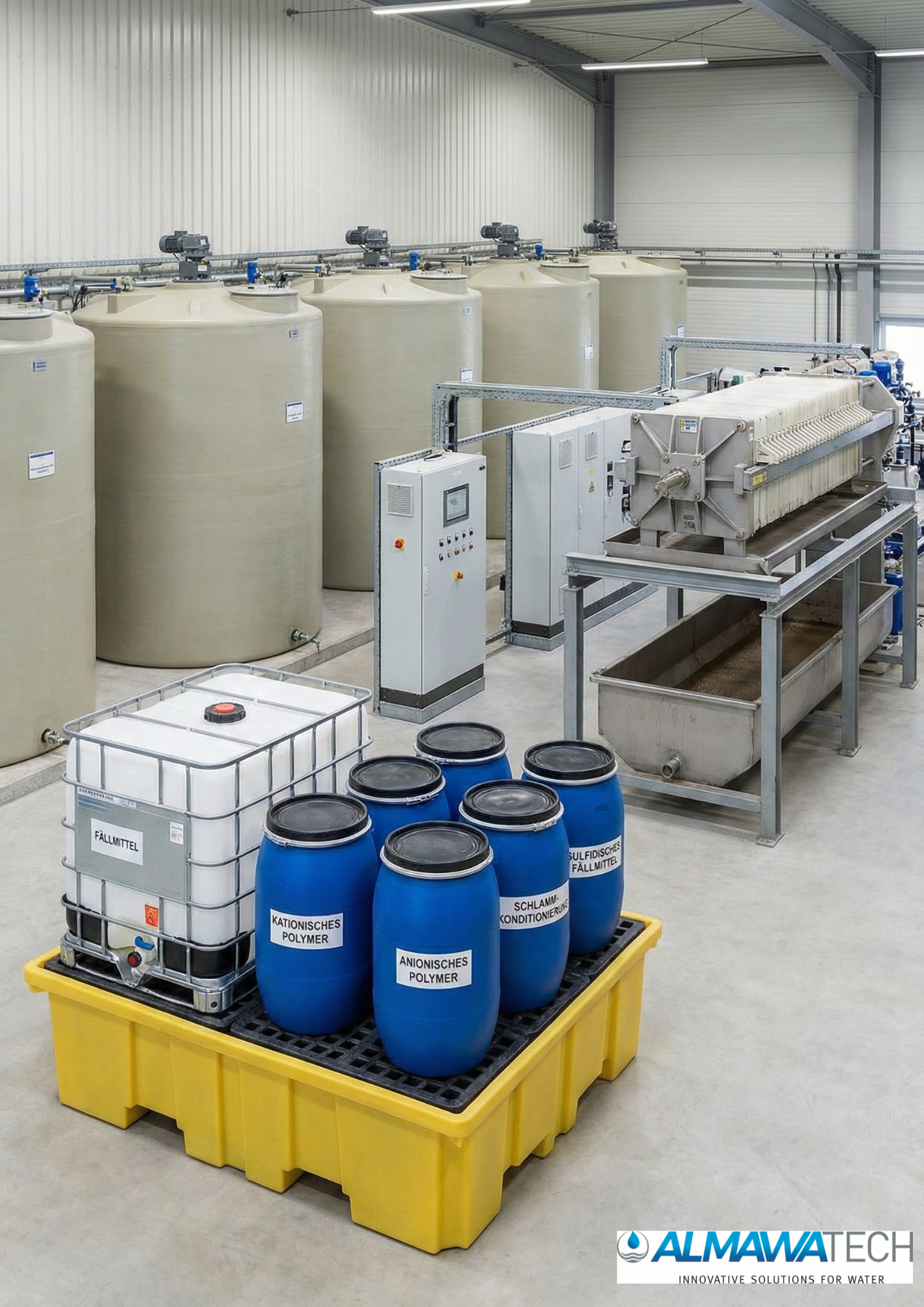
Chemical wastewater treatment uses a sequence of targeted reactions to convert dissolved and colloidal substances into a separable solid phase. Precipitants, neutralizing agents and flocculants form the central active ingredient system, which determines how stable and efficient wastewater treatment is by coordinating the entire process chain.
Precipitants are used to convert dissolved substances - such as heavy metals, phosphates or carbonates - into poorly soluble compounds.
On contact with water, they dissociate to form metal ions, which react chemically with the anions present and form insoluble particles. These particles are usually very fine and initially colloidal, i.e. they remain in suspension for a long time without further treatment.
Iron and aluminium salts are most commonly used because they cover a broad spectrum of activity, are easy to control and also have an adsorptive effect on accompanying substances.
While iron compounds are particularly resistant to complexing substances and are suitable for heavily contaminated industrial wastewater, aluminium salts produce more compact flocs with a lower sludge volume.
Neutralization plays a major role in this reaction chain because almost every chemical transformation in water is pH-dependent.
If the wastewater is too acidic or too alkaline, many precipitants remain in solution or form unstable hydroxide structures that do not form viable flocs.
This is why the pH value is brought into the optimum reaction range with suitable neutralizing agents - such as caustic soda, milk of lime, magnesium hydroxide or CO₂.
Neutralization therefore not only ensures corrosion protection and occupational safety, but above all the right chemical environment in which the precipitants can develop their maximum effectiveness.
The flocculant then takes on the role of the "binding element".
After precipitation, millions of microscopically small particles are present in the water, whose electrical surface charge causes a natural repulsion.
Flocculants - usually long-chain polymers - bridge these particles and bring them together into macroscopic flocs through adsorption and bridging mechanisms.
These flocs are stable, can be separated quickly and can be easily filtered, floated or sedimented.
Depending on the charge character of the wastewater, anionic, cationic or non-ionic polymer types are used, whose molecular weight and structure are specifically adapted to the preceding precipitation chemistry.
The interaction of the three additive groups is highly sensitive:
The precipitants determine the chemical reaction and substance binding, the neutralization determines the reaction conditions, and the flocculants form the resulting particles into a stable, separable solid phase.
A reproducible process with clear effluent quality, low chemical consumption and easily dewaterable sludge can only be achieved if the concentration, sequence and dosing points are precisely coordinated.
In industrial applications, this finely tuned interaction is crucial to ensure constant discharge values and high operational reliability even with fluctuating wastewater loads.
Here, it is not the quantity of chemicals but the quality and coordination of the additives that determines the success of the process.
Which precipitants and flocculants are technically most suitable for industrial wastewater?
The selection of the right precipitant is based on the ion matrix, the target parameter and the desired sludge quality.
Iron(III)-based precipitants (FeCl₃, Fe₂(SO₄)₃):
Particularly effective for phosphate and heavy metal precipitation (e.g. Pb, Cu, Ni, Zn)
Wide pH application range (6-9)
also promote oxidation reactions (e.g. with H₂O₂ in Fenton systems)
Aluminum-based precipitants (Al₂(SO₄)₃, NaAlO₂):
produce compact flocs with low residual turbidity
Ideal for filtration or DAF systems where sludge volume and clear water quality are crucial
Mixed precipitants (Fe/Al combinations):
combine reaction rate (Fe) and compact formation (Al)
stabilize the process during load peaks or fluctuating pH
Sulphidic precipitants (Na₂S, NaHS, thioacetamide):
Selective precipitation of precious and heavy metals in a complex matrix
Bilden schwerlösliche Sulfide (z. B. CuS, PbS) mit extrem niedrigen Löslichkeiten (<10⁻²⁰ mol²/l²)
ALMA AQUA offers organically stabilized sulphide donors for this purpose, which enable controlled release without the risk of H₂S
Flocculants (polymers):
Selection according to charge type, molecular weight and chain structure
anionic types for metal hydroxides, cationic types for organic sludges
Dosage typically 0.1-3 g/m³, depending on floc density and reactor hydraulics
In der Praxis werden Fällung und Flockung in mehrstufigen Reaktoren oder LAPS-Systemen kombiniert, um die Reaktionskinetik zu optimieren und die Schlammstruktur zu stabilisieren.
Das Ergebnis: niedrige Restmetallwerte (< 50 µg/l), gut entwässerbarer Schlamm und eine hohe Prozessrobustheit gegenüber Belastungsschwankungen.
When and how are oxidizing agents and Fenton systems used in chemical wastewater treatment?
Oxidation processes are a central component of chemical wastewater treatment, especially for wastewater with a high organic load, substances that are difficult to degrade or substances containing complexing agents.
While precipitation and flocculation are based on the formation of poorly soluble solids, oxidation processes are aimed at the chemical conversion or destruction of dissolved organic molecules.
The oxidation power is used specifically to mineralize, detoxify or modify substances so that they can be removed more easily in subsequent treatment stages.
Oxidizing agents such as hydrogen peroxide, sodium hypochlorite or persulphates are often used in upstream process stages to break down organic residues, dyes, surfactants or interfering complexes.
These additives work via electron transfer processes in which the oxidizing agents themselves are reduced while the target substances are oxidized and thus destroyed or changed in their molecular structure.
In industrial wastewater, this reaction is often used to break down complexing agents such as EDTA or citrates, as they hold metals strongly in solution and prevent precipitation.
Only after oxidation are these metals chemically available again and can then be safely precipitated using conventional precipitants.
The Fenton process is an extended form of these oxidation reactions.
It combines an iron source (usually iron(II) ions) with hydrogen peroxide to generate reactive oxygen species.
These short-lived radicals are extremely strong oxidants and attack even stable organic bonds - such as aromatic rings, chlorine compounds or polyethylene oxide structures.
As a result, even substances that cannot be sufficiently removed biologically or by simple chemical oxidation can be broken down.
In industrial applications, such as in the chemical, pharmaceutical, textile or paint industries, the Fenton process is used to convert toxic, colored or COD-intensive compounds into safer intermediate products.
Reaction control is crucial for practical operation.
The oxidizing agents must be dosed in such a way that they have sufficient reaction partners without breaking down into side reactions.
Too high a concentration can, for example, lead to hydrogen peroxide itself breaking down into oxygen and water without oxidizing organic substances.
The pH value also plays a key role: Fenton reactions are particularly efficient in the acidic range, while many other oxidation systems - such as hypochlorite or persulfates - also work well in a neutral or slightly alkaline environment.
In process practice, oxidizing agents and Fenton systems are often used upstream of a precipitation or flocculation stage.
This releases previously stably bound metals, destroys complexed organic substances and significantly reduces COD values.
This leads to greater process stability in the downstream chemical and biological stages and at the same time reduces the overall consumption of precipitants.
The combination of targeted oxidation chemistry with classic additives creates a multi-stage, reaction-optimized system that not only enables safe compliance with legal limits, but also improves the long-term stability of the entire wastewater process.
If designed correctly, these processes can significantly improve effluent quality and reduce the need for chemicals - especially in complex industrial applications with fluctuating material flows.
When does it make sense to use sulphide precipitants and what are their particular advantages over hydroxide precipitants?
Sulphidic precipitants are used when conventional hydroxide or carbonate precipitants reach their limits - for example, in the case of very low residual metal requirements or in wastewater containing high levels of complexing agents.
Their active principle is based on the high chemical affinity of many heavy metals to sulphur, which results in extremely poorly soluble metal sulphides. These compounds have a significantly lower solubility than corresponding metal hydroxides and thus enable residual concentrations in the lower µg/l range.
In practice, sodium sulphide (Na₂S), sodium hydrogen sulphide (NaHS) or organically stabilized sulphide dispensers are usually used, which release sulphur in a controlled and uniform manner.
This stabilization is crucial, as pure sulphides can lead to the formation of hydrogen sulphide (H₂S) - a toxic and odorous gas - if dosed incorrectly.
Stabilized products, on the other hand, act slowly, uniformly and without significant gas development, which makes the process safe and controllable.
Sulphide precipitation is preferably used for wastewater containing precious metals, lead, copper, cadmium or mercury. It is also often part of the process in galvanic processes or electronic scrap processing.
Another advantage is selectivity: as sulphide reacts more strongly with soft metal ions (according to HSAB theory), certain metals can be specifically removed from complex mixtures while others remain in solution.
The process is usually carried out after upstream neutralization, often in a slightly alkaline environment. Stable dosing, intensive mixing and a subsequent flocculation stage are crucial for reliably separating finely dispersed metal sulphides and making them filterable.
The sludge structure can be further improved by combining it with anionic polymers or iron precipitants.
Sulphidic systems are therefore a precise tool for the fine purification of metal-containing wastewater and an ideal supplement to conventional precipitation processes - especially when limit values below 0.1 mg/l are required or complexing agents prevent conventional precipitation.
How does wastewater containing complexing agents affect chemical treatment and how can these impurities be effectively broken down?
Complexing agents such as EDTA, NTA, citrates, tartrates or amines represent one of the greatest challenges in industrial wastewater treatment.
They bind metal ions into stable chelate complexes and prevent them from precipitating as hydroxides or phosphates through conventional precipitants.
Even high precipitant concentrations then only lead to incomplete reaction or residual values significantly above the limit values.
Oxidative precursors are used to treat wastewater containing complexing agents.
Oxidation attacks the organic ligands at their functional groups and splits them so that the bound metals are once again present as free ions.
Depending on the matrix, hydrogen peroxide, hypochlorite, ozone or persulphates are used.
In more difficult cases, Fenton reactions or combined oxidation/precipitation systems are used, in which metal release and binding take place in a single step.
Alternatively, a pH strategy can also be used:
With a gradual increase in pH, the complex equilibria change, which initially releases weaker bound metals.
This allows a gradual precipitation, for example first for copper, then for zinc or nickel.
Another key is the hydraulics and contact time.
Complex cleavage is kinetically slower than a simple precipitation reaction - sufficient reaction time, intensive mixing and temperature control are therefore necessary to achieve complete conversion.
Through a combination of oxidative digestion, graduated precipitation and precise pH control, even highly complexed industrial wastewater can be treated safely.
ALMA AQUA process additives enable targeted adjustment of the reagent composition in order to maximize the efficiency of complex destruction and precipitation yield.
What factors determine the quality and dewaterability of sludge from chemical wastewater treatment?
The quality of the sludge produced is a decisive criterion for the operational safety and economic efficiency of a chemical wastewater treatment plant.
It influences not only the disposal costs, but also the process stability, the clear water quality and the energy requirement of the subsequent dewatering.
A good chemical sludge is characterized by compact, dense flocs with a homogeneous structure, low water binding and clear phase separation.
These properties are only achieved if the chemical reaction conditions are optimally adjusted - in particular pH value, dosing points, additive quantities and agitation intensity.
If the pH value is varied too much, amorphous, gelatinous hydroxides are formed, which trap a lot of water and are difficult to dewater.
If the precipitant is added too quickly or unevenly, this leads to locally supersaturated areas in which microflocs are formed, which can neither settle well nor be enlarged by flocculants.
The timing of the polymer dosing also plays an important role:
If it is added too early, before hydroxide formation is complete, the polymer adsorbs on unstable primary particles and loses its effect; if it is added too late, the flocs are already so dense that bridging can no longer take place.
In addition to the chemistry, ionic strength, temperature and filler content also influence the sludge structure.
High salt contents can limit the effectiveness of polymers, while low temperatures reduce the reaction kinetics and dewatering speed.
The selection of process additives - especially the polymer types - is therefore precisely matched to the operating conditions.
The goal is a mechanically stable, easily dewaterable sludge with minimal volume and the lowest possible residual water content.
Such a sludge significantly reduces disposal costs and improves the overall balance of the plant.
Well-coordinated precipitation and flocculation systems, such as those offered by ALMA AQUA, make a decisive contribution to ensuring this quality in the long term.
How do you choose the right flocculant and what factors determine its effectiveness in chemical wastewater treatment?
The selection and dosing of the appropriate flocculant is one of the decisive steps for the performance and stability of a chemical wastewater treatment plant.
Flocculants take on the task of forming large-volume, rapidly separable aggregates from fine, mostly colloidal particles.
They do not act purely physically, but via specific electrostatic and chemical interactions that depend heavily on the composition of the wastewater.
A basic distinction is made between cationic, anionic and non-ionic polymers.
The effectiveness is based on two main mechanisms: charge neutralization and bridging.
In charge neutralization, negatively or positively charged particles are stabilized by oppositely charged polymer groups, which eliminates electrostatic repulsion.
Bridging, on the other hand, occurs when long polymer chains adsorb simultaneously to several particles and physically connect them.
The result is stable flocs with a significantly larger diameter and higher density, which can be sedimented, filtered or floated much more easily.
The selection of the appropriate polymer type depends on several factors:
Type of precipitant and pH value: Iron or aluminum salts produce differently charged hydroxide flocs. In the case of iron overdosage, there is often a positive surface charge, which favors the use of anionic polymers. In the case of aluminum dominance or organic load, cationic types can be advantageous.
Ionic strength and conductivity: A high salt concentration in wastewater can reduce the effectiveness of charged polymers, as the electrostatic attraction is weakened by the ionic environment. Non-ionic or weakly charged polymers are more stable here.
Temperature and shear stress: Low temperatures reduce the reaction speed and flexibility of the polymer chains, while high shear forces (e.g. in agitators or pumps) can break up flocs again. This is why coordinated hydraulics are just as important as the chemistry itself.
Time and place of dosing: The polymer must be added precisely when the primary flocs have already formed but have not yet sedimented. Dosing too early leads to unstable microflakes, too late to incomplete bridging.
The concentration of the polymer in the dosing solution also plays a role:
Solutions that are too dilute lead to uneven distribution and incomplete adsorption, while solutions that are too concentrated lead to local overdosing and inhomogeneities.
On an industrial scale, concentrations of 0.05 - 0.2 % in conjunction with an intensive but brief mixing phase have proven successful.
In practice, a well-tuned flocculation system is characterized by clear phase separation, low residual turbidity and a compactly dewaterable sludge.
Fine-tuning and type selection are usually carried out on the basis of laboratory tests (e.g. jar tests) and subsequent process optimization under real conditions.
Experience shows that an optimally selected polymer not only increases the separation performance, but also reduces the precipitant requirement, improves the sludge volume index and noticeably reduces the operating costs of the overall system.
This is why the selection of the right flocculant is always a chemically and procedurally coordinated process in which the product, dosing strategy and system hydraulics must be precisely coordinated.
Need technical advice? Inquire now!
Frank Kuntze
Sales Manager Water and Process Additives