
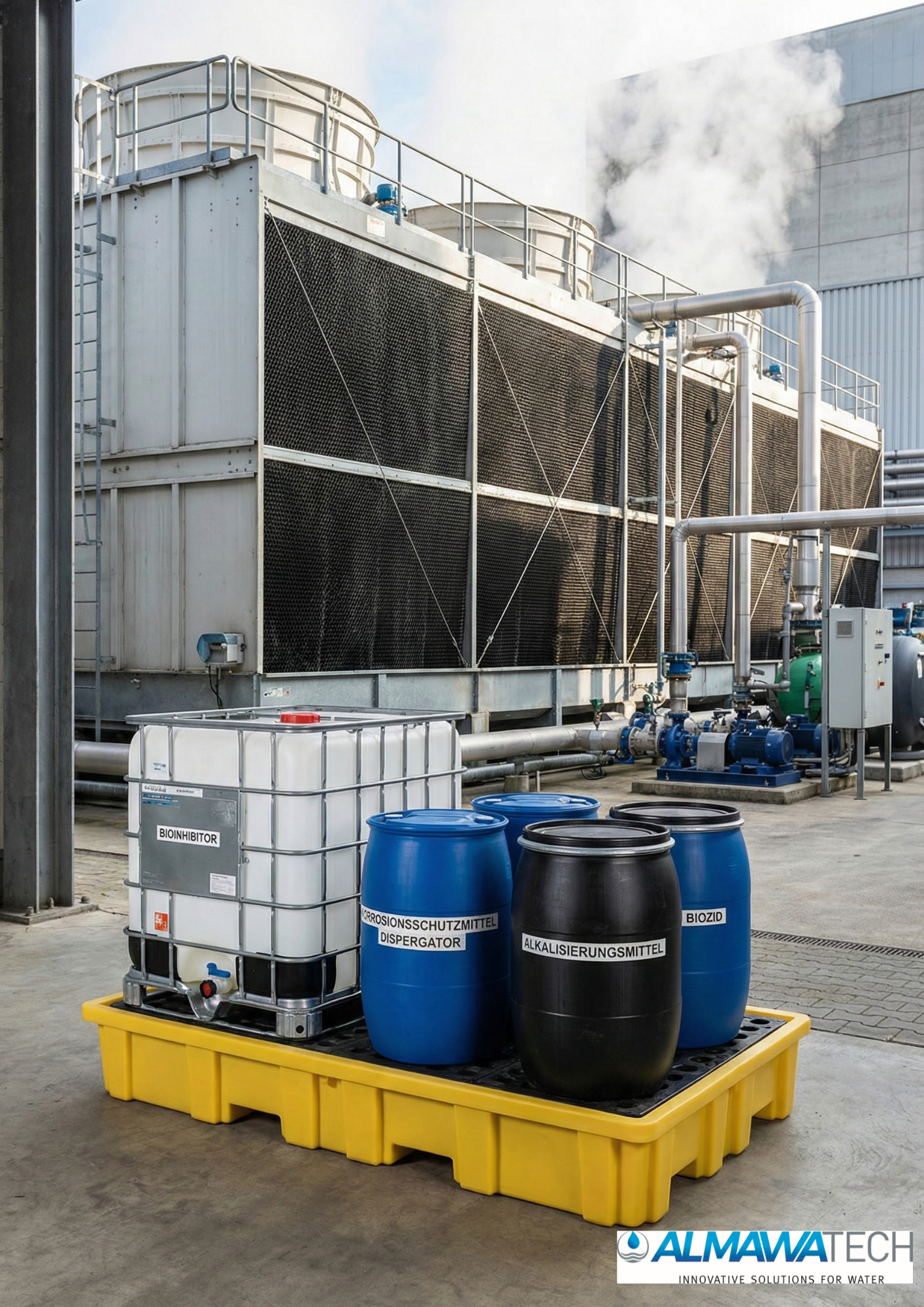
Operating cooling water circuits reliably
Ensure the trouble-free operation of your cooling water systems - talk to our experts!

Frank Kuntze
Sales Manager Water and Process Additives
Objectives of the treatment of cooling water circuits
Proof of Performance - Our references





Your advantages with ALMA AQUA
Standards and guidelines
Process additives & service - everything from a single source
Advice & system recording
Target definition
Product recommendation & treatment concept
Dosing and monitoring concept
Sampling & detection
Evaluation & reporting
FAQ
What role does legionella prevention play in the operation of cooling water circuits?
Legionella are rod-shaped bacteria that can multiply rapidly in warm water (25-45 °C). Aerosols are produced in evaporative cooling systems, cooling towers and wet separators, through which legionella can enter the ambient air and cause serious lung diseases (legionellosis). They are therefore one of the most critical hygienic risks in the operation of cooling water circuits.
Strict requirements apply in Germany and Europe:
42nd BImSchV: Operators are obliged to regularly monitor cooling systems, carry out microbiological tests and document all results.
VDI 2047 Sheet 2: requires the hygienic operation of evaporative cooling systems, including clear specifications on sampling, measurement intervals, action plans and documentation requirements.
Our OEM process additives and concepts ensure legionella control on several levels:
Biocides and biocide combinations for the targeted reduction of legionella populations and other microorganisms.
Individually adjusted dosing and monitoring settings to ensure that the effect remains constant and compliant.
Regular sampling and verification in accordance with legal requirements so that operators are legally protected.
Reporting for authorities and inspection bodies as complete proof of hygienically safe operation.
Conclusion: Our products and monitoring concepts effectively minimize the risk of legionella outbreaks, reliably meet the requirements of the authorities and ensure hygienic operation.
How do process additives support compliance with standards and guidelines in the cooling water circuit?
The legally compliant operation of cooling water circuits requires compliance with several technical standards and legal requirements. These are particularly relevant:
VDI 2047 Sheet 2: Hygienic operation of evaporative cooling systems to avoid legionella risks.
42nd BImSchV: Obligation to regularly monitor, document and report when limit values are exceeded.
DIN EN 16798 / VDI 3803: Requirements for ventilation and air conditioning systems with water-bearing circuits.
AGFW worksheets: Specifications for district cooling and special applications.
In order to comply with these standards, the operating parameters must be kept chemically and biologically stable. This is where process additives come into play:
Corrosion inhibitors form protective layers on metal surfaces and prevent material loss.
Hardness stabilizers and antiscalants bind hardness formers and prevent deposits.
Biocides reduce germs and biofilms and ensure hygienic safety.
pH regulation and defoamer ensure stable process conditions and trouble-free operation.
In addition, the combination of dosing concepts, monitoring strategies and regular sampling is crucial. This is the only way to prove that the cooling water circuit is operated in compliance with the law and at the same time works in an energy and resource-efficient manner.
Result: Our process additives enable operators to seamlessly meet technical and legal requirements, increase system safety and sustainably improve energy efficiency in cooling operations.
How do operating parameters such as conductivity and pH value affect the stability of cooling water circuits?
The conductivity of the cooling water is one of the most important parameters for controlling the water chemistry. It indicates the total concentration of dissolved salts and increases continuously with evaporation in the cooling tower. If the conductivity is too high, this leads to critical oversaturation, causing hardness formers (e.g. calcium or magnesium salts) to precipitate and form deposits on heat exchanger surfaces. These deposits impair heat transfer, increase energy consumption and can cause lasting damage to the system due to scaling.
The conductivity is controlled by controlled blowdown and regulated make-up. In practice, the target value is adapted to the concentration factor of the raw water. Typical values in open circuits are between 1,500 and 3,000 µS/cm, depending on water hardness, materials and operating mode.
The pH value has a direct influence on the tendency to corrosion and deposits.
Bei zu niedrigen Werten (< 6,5) wird die Metallkorrosion durch Säureeinwirkung stark beschleunigt.
If the values are too high (> 9.0), the risk of calcium carbonate precipitation increases.
The aim is to achieve a stable pH range between 7.0 and 8.5 (depending on the system, materials and additives used). This is achieved using pH stabilizers, buffer solutions and targeted additive dosing.
Conclusion: Only by continuously monitoring and adjusting the conductivity and pH value can the requirements of VDI 2047 Sheet 2 and the 42nd BImSchV be met and energy-efficient, low-corrosion operation ensured.
What role do biofilms play in the cooling water cycle and how are they controlled?
Biofilms are complex accumulations of microorganisms that accumulate in a slime-like matrix on surfaces in the circuit. They often form in areas with poor flow or in heat exchangers with slightly elevated temperatures. Biofilms are problematic because they cause several negative effects at the same time:
Thermal: Just a few tenths of a millimeter of biofilm can reduce the heat transfer coefficient by up to 20 %.
Hydraulic: Biofilms constrict pipe cross-sections, increase the flow resistance and thus the pump energy requirement.
Corrosion: Anaerobic zones can form under biofilms, leading to pitting corrosion.
Hygienic: Biofilms serve as a reservoir for pathogenic germs, especially legionella, which can protect themselves from biocides.
The control of biofilms requires a multi-stage procedure:
Use of oxidative biocides (e.g. sodium hypochlorite, chlorine dioxide, bromine compounds), which have a broad germicidal effect.
Combination with non-oxidative biocides (e.g. quaternary ammonium compounds), which destabilize biofilms in a targeted manner.
Dispersants and biodispersants that dissolve the extracellular matrix and allow biocides to penetrate the film.
Regular dosing strategies in alternating operation to avoid resistance.
Monitoring through sampling (e.g. heterotrophic bacterial count, ATP measurements) and visual inspections of heat exchanger surfaces.
This ensures that biofilms do not form in the first place or are kept in an area that meets the hygiene requirements of VDI 2047 Sheet 2.
How does the evaporation rate in cooling towers influence the water chemistry and which additives are necessary?
In evaporative cooling systems, part of the cooling water is evaporated, whereby only pure water is released into the atmosphere. All dissolved substances (salts, hardeners, silicates, organic substances) remain in the circuit. This leads to an increase in concentration. This effect is described by the concentration factor, i.e. the ratio of the salt content in the circulating water to the salt content in the raw water.
Example: If the concentration factor doubles from 2 to 4, the precipitation tendency of calcium carbonate increases exponentially. This increases the risk of deposits, which not only hinder heat transfer, but can also cause local overheating and material damage.
These effects need to be controlled:
Hardness stabilizers and antiscalants to bind calcium and magnesium salts so that they do not precipitate.
Corrosion inhibitors to ensure a protective layer on metal surfaces despite increasing salt concentrations.
biocides, as the higher concentration of nutrients also promotes the growth of microorganisms.
Regular desalination to control conductivity and prevent critical oversaturation.
Only a balance between evaporation rate, desalination, dosing and monitoring can ensure stable operation in accordance with the legal requirements (42nd BImSchV, VDI 2047).
How can energy consumption in cooling water circuits be reduced through optimized water treatment?
The energy efficiency of cooling water circuits is directly dependent on the cleanliness and stability of the water-bearing components. Even the smallest faults cause significant additional costs:
1 mm of limescale deposits on heat exchanger surfaces can increase energy consumption by up to 10 %.
Biofilms 0.5 mm thick can impair heat transfer by 20 %.
Corrosion damage leads to pressure losses and increases the energy consumption of pumps.
Optimized water treatment makes a decisive contribution to reducing these effects:
Hardness stabilizers prevent the formation of limescale deposits.
Corrosion inhibitors ensure stable surface protection and prevent pressure loss.
Biocides and dispersants keep surfaces free of biofilms and ensure hygienically safe conditions.
pH stabilizers and buffer solutions ensure the optimum operating range for maximum efficiency.
In addition, continuous monitoring systems (online measurements of pH, conductivity, redox potential) in combination with intelligent dosing strategies can automate operation and optimize chemical consumption.
Conclusion: With targeted water treatment, cooling water circuits can not only be operated in a legally compliant and hygienic manner, but operating costs and CO₂ emissions can also be significantly reduced - an increasingly important factor for companies with sustainability strategies.
How does the process of optimizing a cooling tower with ALMA AQUA work?
The adjustment of a cooling tower requires a systematic approach in which all water chemistry, operational and hygiene aspects are taken into account. ALMA AQUA accompanies operators step by step:
System survey: First, the system technology, operating mode and the raw water quality used are recorded. Important parameters include conductivity, hardness, pH value and oxygen content.
Target definition: Together with the operator, priorities such as energy efficiency, corrosion protection or legionella control are defined.
Product recommendation: Based on the analysis, we select the appropriate process additives (e.g. hardness stabilizers, biocides, corrosion inhibitors).
Dosing and monitoring concept: We define dosing points, quantities, cycles and limit values for online monitoring. In doing so, we ensure compliance with VDI 2047, 42nd BImSchV and company-specific specifications.
Sampling & validation: Water samples are taken during operation and analyzed for microbiological, corrosive and scaling-relevant parameters.
Adjustment & optimization: The results are integrated into the operational management so that the cooling tower runs in a permanently energy-efficient, compliant and hygienically safe manner.
In this way, we not only ensure technical stability, but also legal compliance with the authorities and the economic efficiency of the cooling tower.
What services does ALMA AQUA offer for the ongoing operation of cooling water circuits?
Our work does not end with the one-off adjustment of the system; we support operators throughout the entire life cycle of their cooling water circuits. Typical services include
Regular sampling and laboratory analyses to ensure compliance with all limit values (chemical and microbiological).
Monitoring concepts with continuous control of pH, conductivity, redox potential and bioindicators.
Reporting and documentation for submission to supervisory authorities within the framework of the 42nd BImSchV.
Adaptation of dosing strategies to seasonal fluctuations, load changes and raw water quality.
Technical advice in the event of malfunctions or anomalies during operation.
Training for operating personnel so that the systems can be managed and monitored correctly on site.
In this way, the cooling tower is not just adjusted once, but remains permanently stable, energy-efficient and hygienically perfect in operation.
ALMA Trol Std Assembly

Need technical advice? Inquire now!

Frank Kuntze
Sales Manager Water and Process Additives