

ALMA AQUA process additives
We ensure smooth water processes in your food production!

Frank Kuntze
Sales Manager Water and Process Additives
ALMA AQUA solutions for the food industry
ALMA AQUA boiler
ALMA AQUA Mem
ALMA AQUA cooling water
ALMA AQUA Waste water
Proof of Performance - Our references




Practical benefits for operators
Service & technology - everything from a single source
Advice & system recording
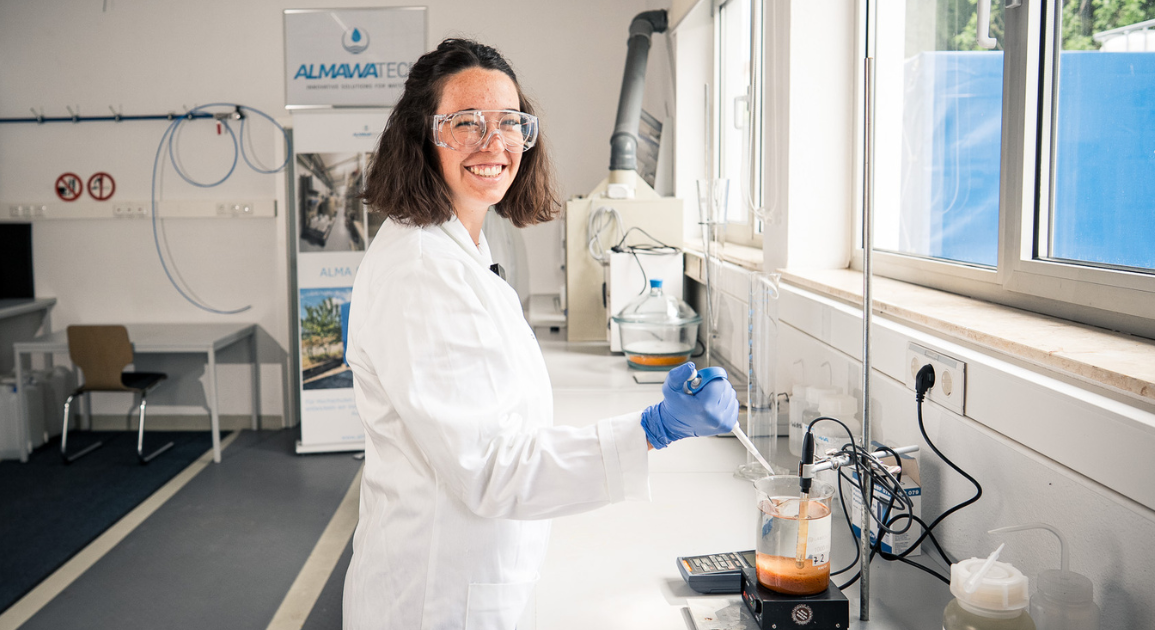
Laboratory and practical tests
Online monitoring & software solutions
Integrated dosing and control technology
Automated additive replenishment
Evaluation & reporting
Formulations & compatibility
OEM & private label solutions
FAQ
Which process additives are particularly suitable for use in the food and dairy industry?
Our ALMA AQUA process additives for the food and dairy industry are specially tailored to hygiene-critical plant areas. They meet all relevant legal requirements - including EU regulations on food safety, drinking water regulations, VDI 2047 Sheet 2 - and are formulated in such a way that they have no negative impact on product quality or production hygiene.
These include, among others:
Corrosion inhibitors, hardness stabilizers, dispersants and biocides for evaporative cooling systems & cooling water circuits
Oxygen binders, alkalizing agents, hardness stabilizers and defoamers for boiler and steam boiler systems
Antiscalant, special cleaner and cleaning booster for membrane systems, e.g. in milk and whey concentration
Precipitants, flocculants, trace substances and sludge conditioning agents for wastewater treatment
All products are developed to ensure operational safety, energy efficiency and hygiene standards in the long term - even in systems with high cleaning cycle requirements (CIP) and with seasonal production fluctuations.
How do ALMA AQUA process additives help to comply with hygiene standards in cooling, boiler and membrane systems?
Hygiene is paramount in the food industry - even minimal deposits or biofilms can cause product failures, contamination or recalls. Our additives have a preventive and process-stabilizing effect here:
Biocides and bioinhibitors prevent biofilm formation in cooling and hot water systems, minimizing the risk of legionella
Hardness stabilizers and antiscalants prevent limescale and milkstone deposits in heat exchangers, evaporators and membranes
Oxygen binders and corrosion inhibitors protect metallic surfaces from corrosion and material loss
Precipitants and flocculants ensure stable discharge values in wastewater treatment and avoid load peaks
In combination with our dosing and control technology and online monitoring systems, we can ensure in real time that the systems are operated within the optimum hygiene window.
How does the product selection process work for a dairy or food manufacturer?
We rely on a systematic, data-based approach:
Analysis: We take water and process samples on site and analyze them in our laboratory for hardness constituents, corrosion potential, microbiological contamination and organic residues.
Simulation: We use jar tests and laboratory tests to simulate the effect of various additives under realistic process conditions - e.g. typical contamination from milk fats, proteins or cleaning agent residues.
Optimization: Based on the results, we configure a tailor-made additive combination to suit your cooling, boiler, membrane and waste water systems.
Integration: We ensure smooth integration into your dosing and monitoring technology and support the start of live operation.
Continuous support: We ensure permanently stable and hygienic system conditions through regular checks, laboratory analyses and data monitoring.
How can legionella be kept permanently under control in evaporative cooling systems and cooling water circuits without affecting food production?
Legionella control in the food industry is particularly challenging, as biocides and bioinhibitors must be highly effective, but at the same time must not leave any negative residues in areas close to the product.
Our strategy is based on three pillars:
Chemical prevention: Use of fast-acting, food-safe biocides in combination with bioinhibitors that prevent the formation of new biofilm. The formulations are adjusted so that they remain stable even with frequent CIP cycles and changing operating temperatures.
Hydraulic optimization: Ensuring an even flow through all parts of the system to avoid "dead zones" in which legionella could multiply.
Monitoring & documentation: Continuous online monitoring of conductance, pH and residual biocide values as well as microbiological laboratory analyses. Results are documented in the digital reporting system to demonstrate VDI 2047-2-compliant operational management.
In this way, we ensure that the systems run permanently in the hygienic operating range without disrupting production processes.
How can additives minimize the influence of milk stone, protein and fat deposits in membrane systems?
Specific organic and inorganic contamination occurs in dairies, which classic antiscalants often do not fully address. Milk stone (calcium phosphate), protein residues and milk fats lead to a twofold load on the membrane surface: a mineral and an organic component.
Our solution:
Special antiscalants that disperse both mineral hardeners and organic matrix components.
Cleaner combinations of alkaline grease solvents and acidic milk scale removers, used sequentially to remove stubborn deposits without leaving any residue.
Cleaning boosters that improve surface tension and penetration, which shortens cleaning times.
Laboratory and operating results show that this combination keeps the permeate performance at a high level for up to 15-20 % longer before cleaning is necessary.
How do seasonal production fluctuations influence the dosing strategy for process additives?
Many dairies and food companies run peak loads in certain seasons - e.g. in the peak milk phase in spring/summer - and reduce production in other months.
The problem: a rigid dosing strategy leads to over- or underdosing in these phases.
Our approach:
Use of load forecasts (based on production data) in conjunction with automated dosing systems.
Adjustment of additive dosing in real time via flow measurements, conductivity and temperature data.
Implementation of "pulse dosing" for short-term production peaks to ensure immediate protection in the event of increased load input.
The result: Constant system protection with simultaneous optimization of chemical consumption, even with fluctuating production volumes.
How are process additives used in wastewater treatment to ensure stable effluent values despite variable loads?
Wastewater from food processing varies greatly in composition - especially during batch production and CIP discharges. Without a targeted additive strategy, this can lead to fluctuations in COD, fat content and solids concentrations.
Our approach:
Precipitants and flocculants are dosed depending on the load in order to bind fine particles as well as fat and protein flocs.
Polymers with a specific charge density ensure a sludge that is easy to dewater, which increases press and centrifuge performance.
Trace substance additions support biological wastewater treatment by ensuring a balanced nutrient ratio (C:N:P).
The result: Stable discharge values even with strongly fluctuating loads - and at the same time an optimization of sludge treatment costs.
Need technical advice? Inquire now!
Frank Kuntze
Sales Manager Water and Process Additives