

ALMA AQUA process additives
We ensure the operational safety of your water-bearing systems in the metal industry!
Frank Kuntze
Sales Manager Water and Process Additives
ALMA AQUA solutions for the metal industry
ALMA AQUA boiler
ALMA AQUA Mem
ALMA AQUA cooling water
ALMA AQUA Waste water
Proof of Performance - Our references





Advantages for the metalworking industry
Service & technology - everything from a single source
Advice & system recording
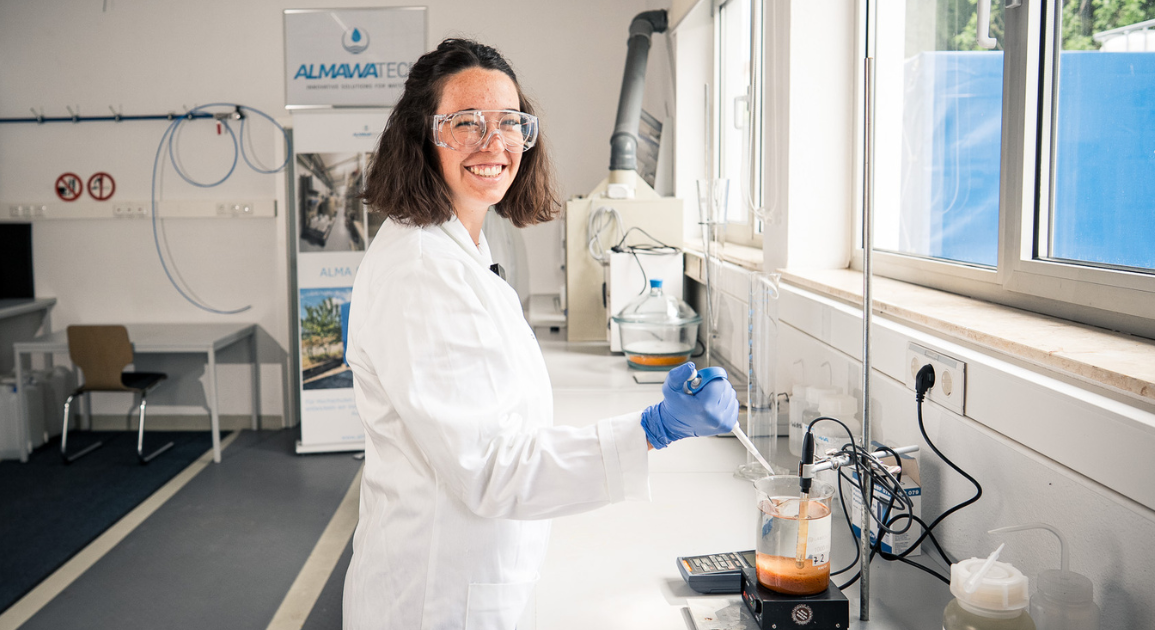
Laboratory and practical tests
Online monitoring & software solutions
Integrated dosing and control technology
Automated additive replenishment
Evaluation & reporting
Formulations & compatibility
OEM & private label solutions
FAQ
How do I achieve safe removal of heavy metals (Ni, Cr, Zn) in electroplating wastewater - even with complexing substances?
For stable compliance with limit values, a multi-stage, robust scheme is recommended, which can be run with our ALMA AQUA process additives with practical reliability:
Preconditioning / reduction
Cr(VI) → Cr(III) using a reducing agent at acidic pH.
If necessary, break the emulsion and surfactant load in advance with de-emulsifier/coagulant so that the subsequent precipitation takes effect.
Precipitation & pH control
Precipitate metals as hydroxides (typically alkaline range) or as sulphides in the case of impurities.
Our pH regulators ensure narrow windows and reduce post-dosing.
Flocculation & separation
Build up micro- to macroflocs with application-optimized flocculants/polymers.
Separation via lamella clarifier/DAF; secondary filter (sand/fine filter) for residual turbidity.
Special case of complexing agents (e.g. EDTA, citrates, amines)
Use of complex-splitting additives or oxidative stages; optionally our neutral pH-capable ALMA AktivFlock combination (precipitation+flocculation+Fenton) to dissolve stable metal complexes and reduce residual COD.
Process notes (industry practice):
Online monitoring: pH/redox/conductivity, periodic ICP/AAS for residual metals.
Sludge management: Trim polymer selection for dewaterability; cake strength reduces disposal costs.
Incident suitability: Provide buffer volume; define recipe with safety windows (temperature, pH, redox).
Benefits: reproducibly low residual metals, robust compliance and lower overall chemical costs thanks to targeted dosing windows.
How do I implement rinse water recycling with membranes (NF/RO) in electroplating - without scaling, fouling and bath repercussions?
A viable concept combines pre-treated rinsing water with membrane-compatible process additives:
Pre-treatment (key to service life):
Fine filtration (e.g. 5-20 µm) for particle reduction, optional activated carbon against organic impurities.
pH trimming and antiscalant dosing against carbonate, sulphate and metal phosphate scaling.
Biofouling prevention through dosed biocides (membrane-compatible, not critical on the bath side).
For high metal loads: Partial precipitation before NF/RO so that the membrane does not become a "metal trap".
Membrane operation:
Clearly define the operating window (transmembrane pressure, recovery, temperature).
Keep SDI/turbidity under control; define CIP strategy (alkaline/acidic/oxidative - material-compliant).
Permeate return: depending on the process, use as rinse water or partially treated bath feed water; treat concentrate in a process-specific manner (e.g. return to the waste water line).
Additive compatibility:
Select antiscalants & dispersants in such a way that no bath disturbances (gloss/deposition errors) occur.
Validate biocides with regard to materials (brass, aluminum, seals) and downstream effects.
The result: lower fresh water consumption, stable coating quality and low operating costs thanks to extended membrane service life.
How do I optimize cooling water and boiler circuits in metalworking companies - corrosion, deposits & microbiology under control?
For high system availability and energy efficiency, we recommend a coordinated additive & monitoring concept:
Cooling water (open/closed):
Corrosion inhibitors (phosphonate/molybdate or organic systems) suitable for materials (CS, Cu alloys, Al).
Hardness stabilizers/dispersants against carbonate and metal phosphate scaling at increased concentration cycles.
Biocide management with rotating insert (oxidative/non-oxidative) for biofouling control, compatible with heat exchanger materials.
Core KPIs: Conductivity (cycles), pH window matching the material, ΔT/ΔP via heat exchanger, ATP/germ count.
Boiler/steam systems:
Sauerstoffbinder (z. B. O₂-Rest < 10 ppb anstreben), Alkalisierungsmittel für Dampfraum-/Kondensat-pH, Härtestabilisatoren gegen Kesselstein, Entschäumer für sauberes Verdampfen.
Desalination control based on conductivity/silicon; consistently ensure feed water quality (softening/RO).
Integration & OEM compatibility:
Our ALMA AQUA process additives are OEM-compatible, can be integrated into existing dosing technology and are coordinated on the bath and waste water side - important for heat exchangers, coating systems and steam generators in surface treatment.
Benefits: lower energy and maintenance costs, consistent production quality and extended system service life.
How can I reliably treat complexing agents such as EDTA or citrates in electroplating wastewater?
Complexing agents bind metals so stably that classic hydroxide precipitation is often not sufficient. This is where we rely on a specialized additive strategy:
Oxidative digestion: By using Fenton-based additives or peroxide systems, stable complexes are broken down so that metals can subsequently be precipitated.
Special precipitants: Organically modified precipitants also react with complex-bound metals and lead to stable, separable flocs.
Process integration: In surface treatment in particular, it is important that these stages can be integrated into existing clarification and rinsing water systems without disrupting production.
Benefit: With our ALMA AQUA specialty additives, legal limits for nickel, zinc and copper can be safely complied with, even with EDTA, citrate or amine complexes.
How do I prevent back contamination from rinsing water from impairing the quality of electroplated layers?
The quality of electroplated coatings depends directly on the purity of the rinsing water. Contamination (e.g. by metals, carbonate hardness or biofilm) leads to stains, clouding or adhesion problems.
Hardness stabilizers keep dissolved calcium and magnesium salts in solution and prevent precipitation in the rinsing bath.
Dispersants and biocides prevent deposits and microbial growth, which would otherwise be introduced into electroplating baths as impurities.
Membrane-compatible additives also enable a rinse water circuit in which permeate is reused as rinse water - without any loss of quality.
Benefits: With the right additives, rinsing baths remain free of interfering back-entry, the coating quality is consistently high and reworking is reduced.
How can wastewater costs in metal processing & electroplating be reduced through the targeted use of process additives?
High waste water costs are incurred in electroplating plants and metal processing - caused by chemical consumption, sludge production, disposal and energy consumption. With the right process additives, this cost item can be significantly optimized without jeopardizing operational safety:
Reduced chemical consumption
Customized precipitants and flocculants efficiently remove metals, particles and emulsions. Targeted dosing strategies reduce the required chemical dose and prevent overdosing.Optimized sludge management
Many standard products generate unnecessarily large quantities of metal hydroxide sludge. Our highly effective special additives form compact, easily dewaterable flocs. This significantly reduces the volume of sludge, lowers disposal costs and facilitates dewatering.Energy and operating cost efficiency
Stable processes mean fewer malfunctions, downtimes and re-treatments. At the same time, additives that are compatible with existing systems (lamella clarifiers, DAFs, filters, membranes) reduce maintenance costs and increase the service life of filters and membranes.Practical example of electroplating operations
The difference is particularly evident in rinsing water treatment systems with highly fluctuating metal loads: with optimized additives, dosing quantities can be reduced by 20-30 %, while at the same time improving the effluent quality - a direct lever for operating costs.
Benefits: With the targeted use of ALMA AQUA process additives, metal processing and electroplating companies achieve a sustainable reduction in wastewater costs, remain reliably within the limit values and at the same time increase their economic efficiency.
Need technical advice? Inquire now!
Frank Kuntze
Sales Manager Water and Process Additives