Overfill protection is a key safety element in industrial water and wastewater treatment plants and in water technology systems. It is used to prevent overflows and protects containers, tanks and pipes from uncontrolled overfilling. Especially in industrial water treatment systems, chemical-physical treatment (CP systems), cooling water circuits and waste water treatment, overfill protection plays a decisive role.
Its function not only contributes to plant safety, but also prevents environmental damage, the loss of valuable media and costly breakdowns or repairs. Modern overfill prevention systems combine mechanical, electronic and automated technologies to ensure reliable protection.
Table of contents
Function and objective of overfill prevention
The purpose of overfill protection is to detect impermissible fill levels in containers or tanks at an early stage and initiate suitable measures to prevent overflow. Safety is of the utmost importance for both liquids (water, chemicals, waste water) and process media.
Objectives of the overfill protection:
- System protection: Prevention of mechanical damage due to overpressure or overfilling.
- Environmental protection: Prevention of the escape of harmful substances and environmental contamination.
- Operational safety: Protection of operating personnel and equipment.
- Cost control: Reduction of media losses and downtimes.
Technical implementation of overfill prevention
The design of an overfill prevention system depends on the type of liquid, the container to be protected and the operating conditions. A basic distinction can be made between mechanical, electronic and automated systems.
1. mechanical overfuses
Mechanical fuses have a simple design, are robust and do not require a power supply. They are often used in applications where a passive fuse is sufficient.
Float switch:
- A mechanical float rises with the liquid level. When a critical level is reached, it triggers a mechanical shutter or an alarm signal.
- Advantage: Low maintenance and reliable with non-reactive media.
- Disadvantage: Limited accuracy, especially with turbulent or viscous media.
Overflow pipes:
- In the event of overfilling, an overflow pipe directs the medium into a collection tank or an emergency drain.
- Advantage: Simple and cost-effective.
- Disadvantage: No active alarm, limited control options.
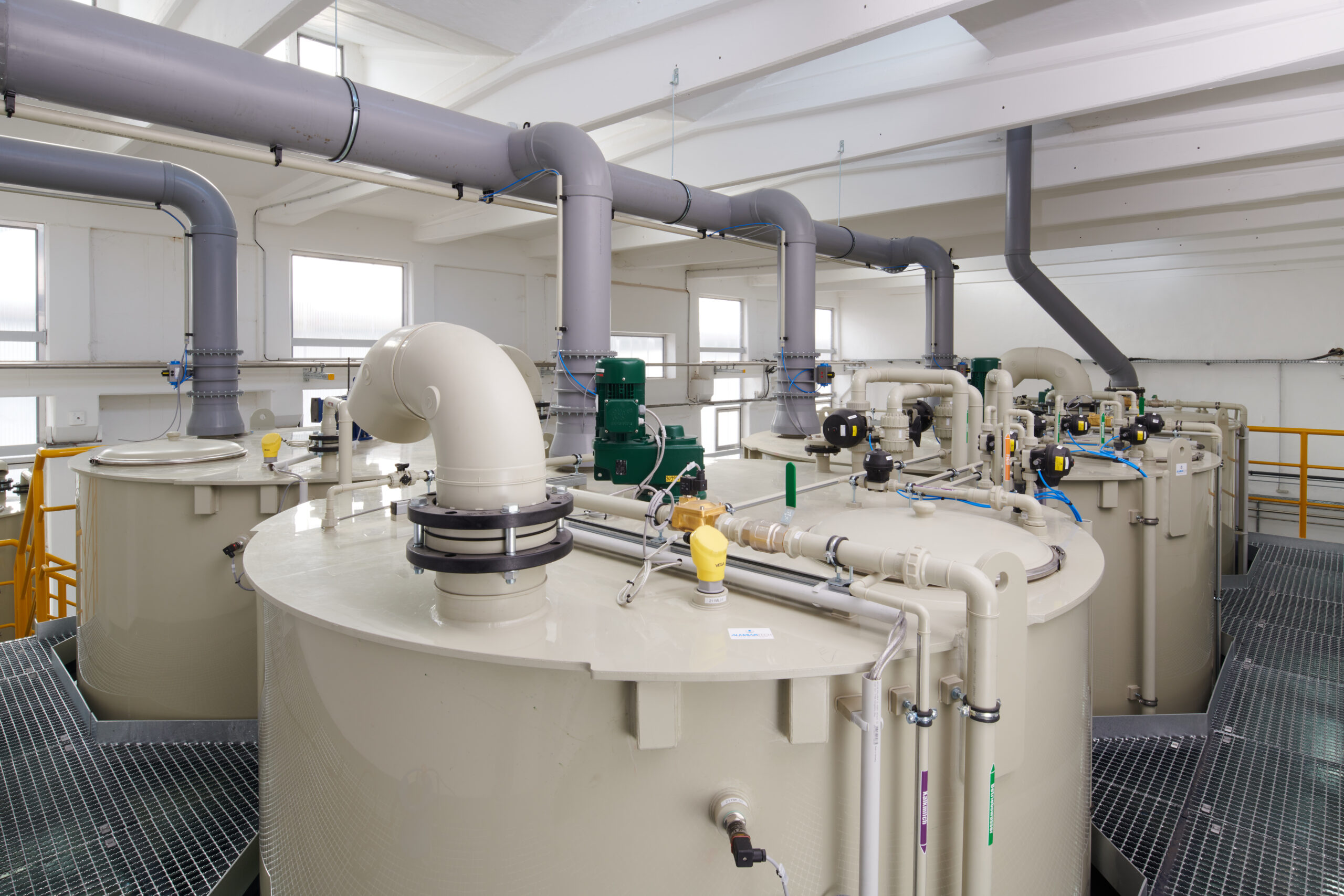
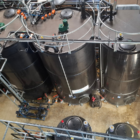
Photo: Reactors and stacking tanks of our CP system ALMA CHEM MCW with oversize sensors built into the side of the tank
2. electronic overfuses
A key feature of modern electronic overfill prevention systems in industrial water and wastewater technology is their reliability and the continuous monitoring of liquid levels. This is achieved by special sensors that provide permanent signals and do not only emit a signal when a critical condition such as an overflow or an almost full tank is detected. As a result, a measurement failure, for example due to a sensor error or a cable break, is reliably detected.
Technical implementation: Permanent signal generation
Classic fill level measurements, such as those with pressure sensors, ultrasonic sensors or simple level switches, can lead to unnoticed failures. A defective sensor or an incorrect measured value could be tacitly accepted, meaning that the container could overflow in an uncontrolled manner. This poses considerable risks, especially when handling harmful substances or chemically contaminated media.
To avoid this, modern overfill prevention systems use measuring methods that are fail-safe and provide a permanent signal. The most important points of this technology are
Continuous signal transmission:
- The sensors permanently emit a measurement signal.
- If the signal fails or remains constant (e.g. due to a cable break or sensor error), this is recognized by the control unit as a fault and an alarm is triggered.
Security logic:
- A missing or unexpected signal is automatically evaluated as a critical status. This means that in the event of a sensor or communication failure, the system is switched to a safe state, for example by switching off pumps or closing valves.
Signal testing and redundancy:
- In safety-critical applications, redundant sensors are often used to check the measurement results. This prevents a single sensor error from jeopardizing the safety of the system.
Advantages of overfill protection
- Operational safety: Protection of systems and components from damage due to overflow.
- Environmental protection: Prevention of uncontrolled leakage of pollutants.
- Cost savings: Reduction of media losses and consequential damage.
- Flexibility: Adaptation to different media, operating conditions and system sizes.
- Reliability: High operational reliability thanks to redundant monitoring systems.
Conclusion
Overfill protection is an indispensable safety system in industrial water treatment and wastewater treatment. It ensures that tanks and containers do not overflow in an uncontrolled manner, which is extremely important for both environmental protection and operational safety.
By using modern technologies such as electronic sensors, mechanical float switches and integration into automated control systems, systems can be reliably monitored and protected. A well-planned and correctly designed overfill prevention system not only contributes to compliance with legal requirements, but also prevents costly failures and damage in industrial processes.
For further information on our products, please feel free to contact us at any time!