Technology, practical knowledge, and solutions for reducing fats (FOG), pH fluctuations, and COD
Dairy wastewater is one of the most challenging types of industrial wastewater: it contains high organic loads, varying fat content, proteins, and cleaning chemicals from CIP processes. At the same time, its composition and flow often fluctuate greatly throughout the day, between product lines, and depending on production and cleaning regimes. Reliable pretreatment before discharge into the sewer system is therefore not only a matter of complying with limit values, but above all a lever for operational safety, fee stability, and predictable processes.
This article shows where and why wastewater is produced in the dairy industry, how wastewater streams differ depending on the product, and which proven technologies have become established in pre-treatment, with a particular focus on lipophilic substances (fats/oils/FOG), pH control, and COD reduction.
Table of contents
Why dairy wastewater must be pretreated
Municipal sewer systems and wastewater treatment plants are sensitive to the typical properties of dairy wastewater:
High COD/BOD due to milk components (lactose, proteins, fats)
Fats/oils (FOG) that clog pipes, interfere with pumps, and lead to deposits
Significant pH fluctuations due to CIP (alkaline/acidic), which disrupt biological processes and attack materials
Suspended solids and flakes that settle in pipes or float/foam in the system
Slug loads – short peaks often determine the design and the risk of fees/disruption
The aim of pretreatment is therefore usually tosignificantly reduce FOG/TSS (
), stabilize the pH, and remove a relevant proportion of the (particulate) COD on site, preferably with manageable CAPEX/OPEX and high robustness.
Where does wastewater originate in the dairy industry? Typical sources of wastewater
In dairies, wastewater does not originate in one place, but is distributed across several areas. When planning pre-treatment, it is crucial to know these sources because they generate different characteristics and peaks:
1) Milk collection & logistics
Rinsing and cleaning water from milk reception areas
Tank truck cleaning (inside/outside)
Losses during transfer (spills): Frequently changing organic cargo, some fat peaks, relatively "short" peaks.
2) Process lines (production)
Separators, homogenizers, pasteurization/UHT
Emptying, product changes, returns: Depending on the product: Fat/protein content varies greatly; often emulsions.
3) CIP cleaning (cleaning-in-place) – the peak driver
alkaline cleaning (typically NaOH)
acid cleaning (depending on operation, e.g., for descaling)
Disinfection steps, surfactants: Leads to pH spikes, temperature spikes, and often to stable emulsions that make separation difficult.
4) Filling, floor cleaning, shift/product change
Cleaning water with product residues
Foam, fine particles, sugar/flavor components (in desserts/yogurt): Highly variable load, often high COD peaks.
5) Scrubber/exhaust air washer (for milk powder/drying)
Scrubber water from dust removal systems: Fine particles, varying loads, usually easily treatable by flotation/precipitation (depending on composition).
6) Brine (typical in cheese production)
Partially high conductivity/chloride: Important for material selection, corrosion protection, and process control.
Why wastewater varies so much depending on the product
A dairy's product range largely determines whether fat, protein, or dissolved organic matter dominates —and thus also which pretreatment is particularly effective.
Cheese & Curd Cheese
high protein/whey content
often high COD/BOD, sometimes P-relevant loads
Depending on the line, more solids (broken pieces): flotation plant with precipitation/flocculation very effective for particulate matter; dissolved matter remains partially.
Butter, cream, cream products
Very high fat content, emulsions: Clear "parade discipline" for DAF flotation (FOG reduction) when pH/emulsions are controlled.
Yogurt, desserts, ice cream mix
Sugar, stabilizers, sometimes high viscosity: Higher proportion of dissolved organic matter, which can, however, be removed by dosing precipitating agents and pressure relief flotation.
UHT/ESL milk
Frequent product changes, regular CIP: pH and temperature peaks dominate; compensation/neutralization become crucial. In some cases, a simple CO2 neutralization system with COD-controlled discharge is sufficient.
Milk powder/spray drying
Intensive cleaning, scrubber water: Frequently changing, fine particles; sensible to use robust preliminary stages + flotation.
The core objectives of pretreatment: lipophilic substances, pH, and COD
In practice, dairy wastewater pretreatment can be broken down into three "main enemies":
Lipophilic substances (FOG/fat/oil): cause deposits, floating, foaming, malfunctions.
pH fluctuations: complicate precipitation/flocculation, increase chemical requirements, and place strain on sewers/systems.
COD: Fee and discharge parameters; particulate COD in particular can be separated economically by flotation.
Best practice technology: Process chain for dairy pre-treatment
1) Screening/fine sieving: protection for everything that follows
Automatic fine screening (e.g., drum screen, often in the range of a few millimeters) protects pumps, valves, and flotation. Especially in dairy wastewater, fibers, lumps, or product residues can quickly lead to malfunctions.
What matters:
Reliable automatic cleaning/backwash
maintenance-friendly design
Meaningful redundancy/bypass strategies for continuous operation
2) The buffer tank: large enough—but not too large
A sufficiently dimensioned buffer/compensation tank is often the most important component for reducing costs in dairies:
It smooths pH and cargo from production and CIP.
This reduces the consumption of neutralizing agents (e.g., NaOH) and makes precipitation/flocculation more stable.
However, the container must not be oversized. Dairy wastewater can acidify if it remains in the container for long periods of time. This causes some of the undissolved organic components to be converted into dissolved organic matter.
Dissolved organic matter cannot then be removed as easily and cost-effectively by flotation with precipitation/flocculation.
Practical principle:
Design buffers so that they reliably "cushion" fluctuations—but do not create unnecessarily long dwell times.
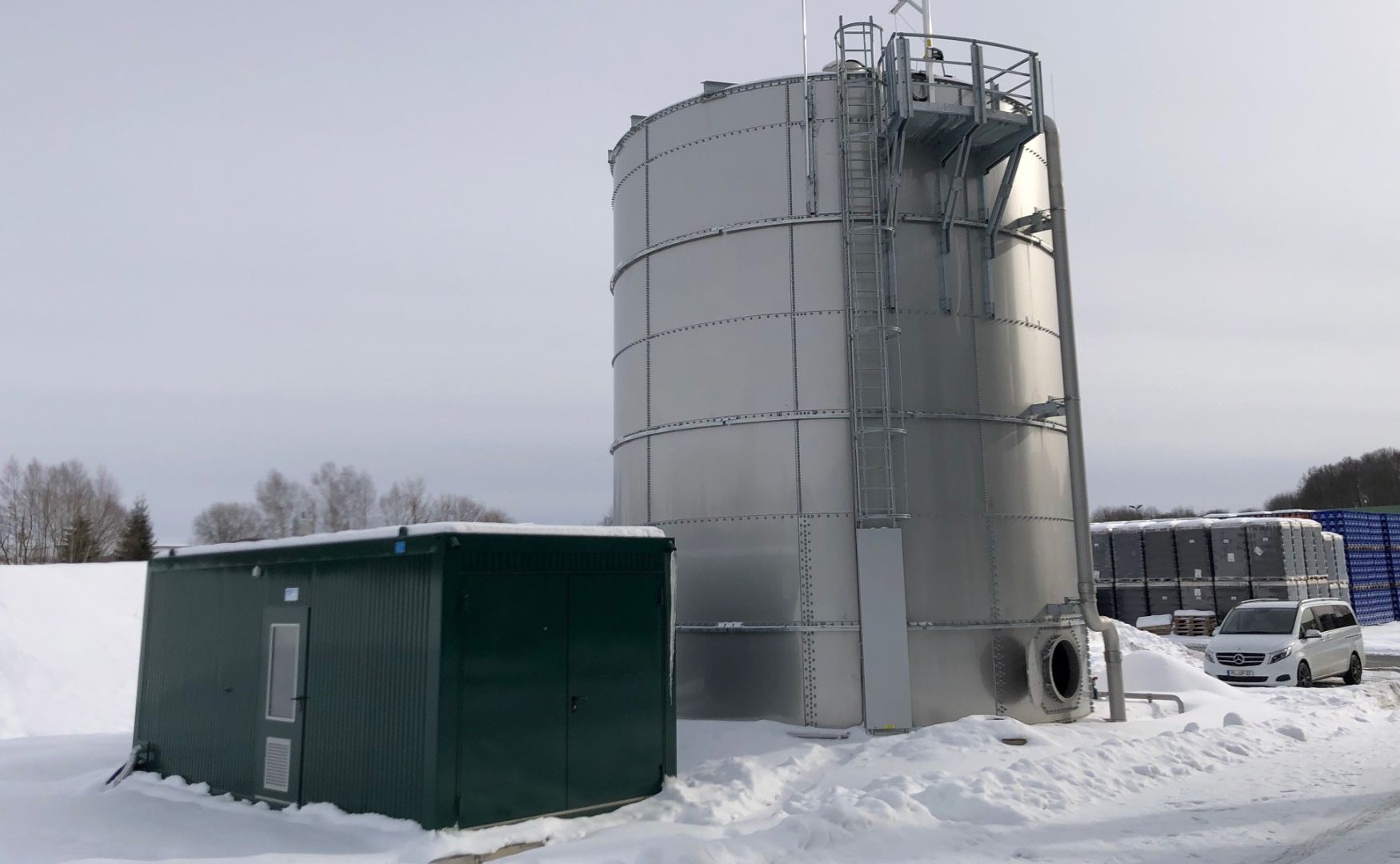
Photo: The correct design of a mixing and equalization tank with external ventilation is crucial for efficient plant operation and semi-biological COD degradation.
3) Why ventilation in the buffer is so beneficial (4 reasons)
A ventilated buffer tank is often the most economical form of "conditioning" for dairy wastewater:
Counteracting acidification: Oxygen slows down anaerobic processes.
Freshness preservation & odor prevention: less H₂S/"rotten" odors, better working conditions.
Partial degradation of COD: When operating with residual volume, a small amount of biology can form, which already degrades part of the COD.
Better flotation properties: more uniform feed, more stable separation in the DAF.
4) Neutralization: pH control as a stability factor
Neutralization (typically with NaOH, often provided by the operator) is crucial in order to:
Comply with introductory requirements,
to stabilize the downstream precipitation/flocculation,
Making emulsions easier to handle.
A clean control strategy with measurement and logging is important:
pH, temperature, and flow rate should be measured and recorded for operation, optimization, and verification purposes.
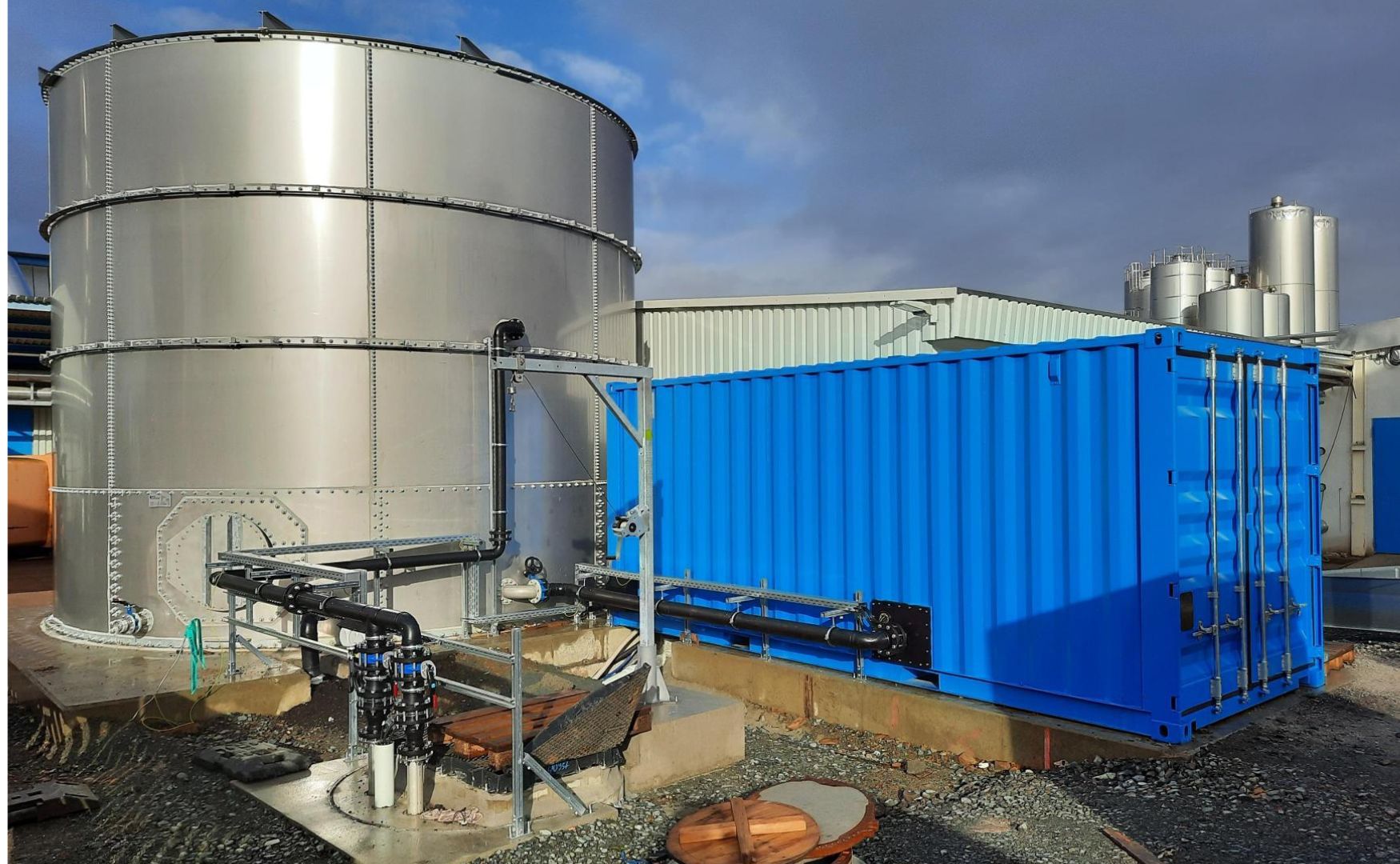
Photo: This photo shows a container-based wastewater neutralization plant that uses CO2 (ALMA Neutra). The advantage of CO2 neutralization is the particularly sustainable mineralization and permanent binding of CO2 in wastewater.
5) DAF pressure relief flotation + precipitation/flocculation: the core of fat/TSS reduction
DAF flotation is one of the most effective and economical pretreatment stages for dairy wastewater when it comes to lipophilic substances and particulate COD.
Technical principle:
Recycled water is saturated with air under pressure (whitewater).
The reduction in pressure causes tiny bubbles to form.
Bubbles accumulate on flakes, fat droplets, and particles → buoyancy → separation as flotate.
In addition, a sediment drain can reliably remove particles that have settled at the bottom.
In dairies in particular, it is crucial that air saturation and valve technology do not become a bottleneck, even when there is a high fat/protein load.
6) Flotate/sludge and dewatering: 18–20% dry matter only with dewatering
In many projects, a high dry matter content in the sludge (e.g., 18–20% DM) is desired. This is usually not realistic without additional technology.
These DM contents can generally only be achieved with sludge dewatering.
Sludgedewatering is therefore often the decisive lever for:
Reduce waste disposal volumes
Simplify logistics
Sustainably reducing operating costs
Our product advantages in dairy pre-treatment
ALMAWATECHpressure relief flotation systemsoffer several technical advantages that ensure high efficiency and operational safety:
Non-clogging expansion valves: The air-saturated water flow is mixed evenly through pneumatic valves that operate without clogging.
Patented, energy-efficient air saturation system: TheVenturi effectefficiently mixes air into the water, reducing energy consumption.
Bubble Booster System: This patented system ensures energy-efficient micro-bubble formation and guarantees the optimum bubble size to maximize floc formation and separation of pollutants.
Load-proportional dosing of operating materials: Inline dosing in our plants is controlled by anonline COD measurement system, which precisely adjusts the precipitating and flocculating agents to the wastewater load. This results in significantsavings in operating costs.
Aerophilic flocculation: The reflux of the air-saturated water stream into the flocculation reactor promotes the formation ofaerophilic flocs, which have better buoyancy and rise to the surface more quickly.
All our pressure relief flotation units are equipped with integrated process control based onALMA Vision softwareinthe Siemens TIA Portal, as well as specially developedALMA AQUA operating materialsfor precipitating agents, neutralizing agents, and flocculants. The optimal operating materials are selected after comprehensive laboratory testing in order to best meet the specific requirements of your wastewater.
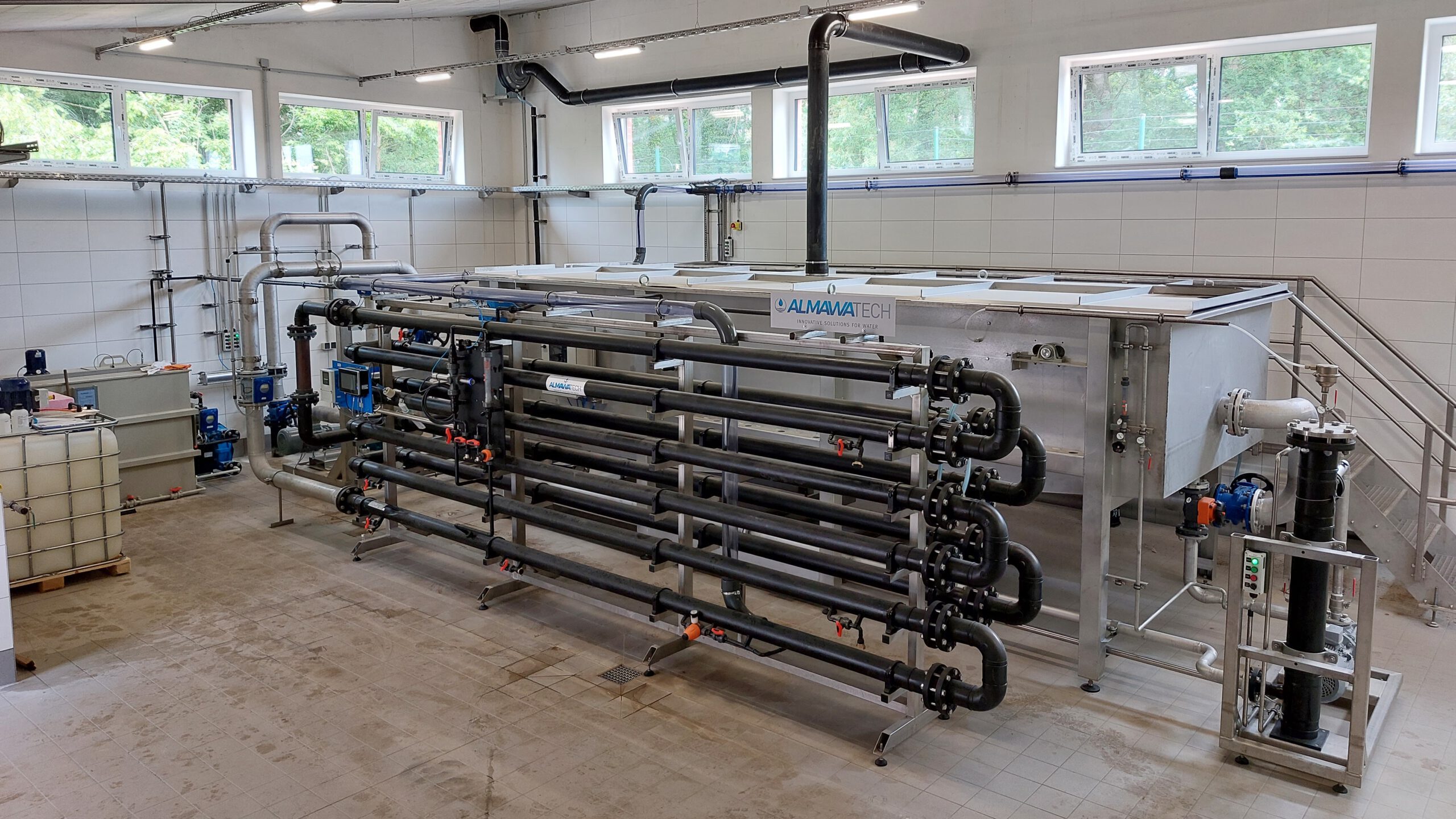
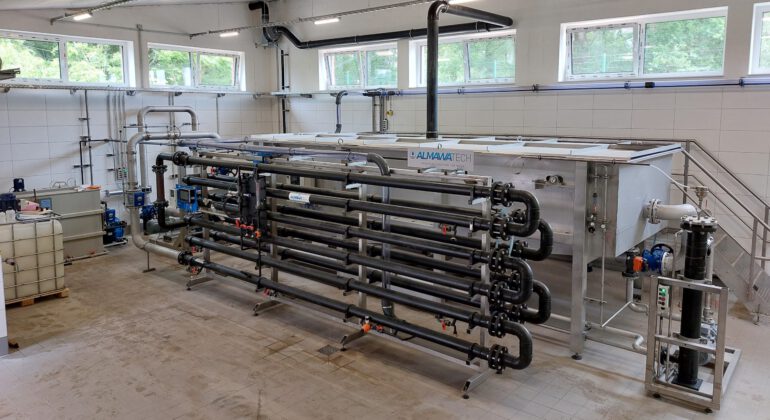
Photo: One of our flotation plants with COD proportional dosing of precipitating agents and our patented ALMA Bubble Booster System.
Conclusion
Modern pretreatment of dairy wastewater before discharge into the sewer system is based on a clear principle:
First stabilize (screening, buffering, aeration, neutralization) – then separate efficiently (DAF flotation) – and optionally dewater economically.
This allows lipophilic substances, pH fluctuations, and a significant proportion of COD to be reliably reduced—with robust operation and predictable costs.
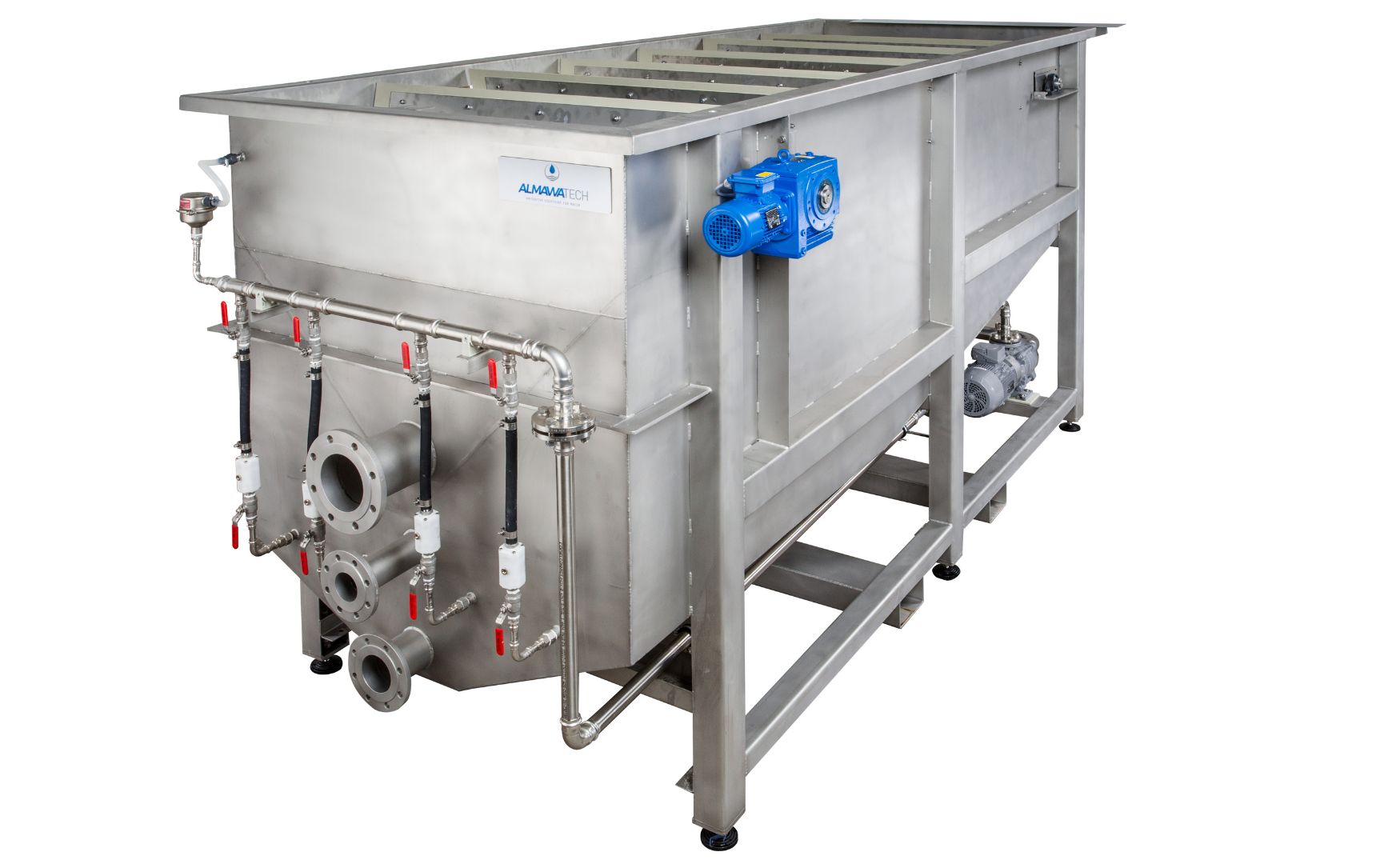
Photo: Front view of our proprietary ALMA NeoDAF flotation cell with sediment discharge