
The evaporation residue refers to the solid and dissolved residues that remain after the evaporation of water or wastewater. These residues consist of non-volatile components such as salts, minerals, organic substances and other impurities that do not escape with the water vapor during the evaporation process and therefore remain concentrated in the residual liquid.
Table of contents
Technical background
The evaporation residue is often used as an indicator of the total load of dissolved and undissolved solids in wastewater. It is usually measured in milligrams per liter (mg/L) and is a key parameter in the characterization of wastewater, especially in industries with high substance loads, such as the chemical industry, food processing or metal refining.
The evaporation residue is determined by evaporating a certain amount of water at a specified temperature until all the water has evaporated. The remaining residue is then dried and weighed. This method is used to assess water quality or to plan wastewater treatment processes.
Significance for the design of wastewater treatment plants
The evaporation residue is a decisive factor in the design and optimization of wastewater treatment plants, especially when processes such as evaporation or evaporation are used to concentrate and remove pollutants. For plants that aim to purify water by evaporation (e.g. evaporation plants or distillation plants), operators need to know the amount of residue that remains in the wastewater.
Highly saline waste water:
In industries such as food processing, the petrochemical industry or electroplating, large quantities of dissolved salts can occur in wastewater. The evaporation residue provides information about the expected quantities of solids that remain after evaporation. This information is crucial for the design of evaporators, as the concentration of solids influences the design of the evaporator and the necessary cleaning intervals.
Sludge and residue removal:
The higher the evaporation residue, the greater the amount of residue that remains as sludge or concentrate after wastewater treatment. These residues must be disposed of or treated further, which incurs additional costs. A precise determination of the evaporation residue helps to plan the optimum size of sludge storage tanks and the disposal logistics.
Corrosion and deposit problems:
If the exhaust vapor residue consists of poorly soluble salts or mineral substances, this can lead to deposits in evaporators, pipes or heat exchangers. This reduces the efficiency of the system and requires frequent maintenance. Wastewater treatment systems, especially evaporator systems, must therefore be designed to withstand the residues and minimize deposits.
Energy efficiency:
A high evaporation residue often means that the wastewater contains a high concentration of solids, which affects the energy efficiency of the evaporation process. More energy is required to evaporate the water and the amount of residue that needs to be treated or disposed of increases. In such cases, it may be necessary to combine wastewater treatment with pre-treatment or CP plants to reduce the amount of solids prior to evaporation.
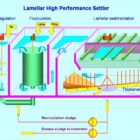
An example of a CP system, also known as a precipitation and flocculation system, is our ALMA CHEM MCW.
Conclusion
The evaporation residue is a key parameter in industrial wastewater treatment and describes the amount of non-volatile substances that remain after the evaporation of wastewater. It plays a key role in the design and efficiency assessment of evaporators and evaporation plants, as high residue levels have a direct impact on energy efficiency, maintenance requirements and disposal costs. Precise knowledge of the evaporation residue enables precise planning and optimization of wastewater treatment processes in industries with high solids loads.