The dry substance content (DS) is a key parameter in water and wastewater technology and describes the proportion of solid substances in a medium in relation to the total weight. It is expressed as a percentage (%) or in grams per kilogram (g/kg) and describes the mass of the remaining solids after the water has been completely removed by evaporation.
The dry matter content provides important information about the consistency of sludges, suspensions or concentrates and is a basis for the evaluation, planning and optimization of processes in water and wastewater treatment.
Table of contents
Technical background
The dry matter content comprises the total mass of solids, which may consist of inorganic and organic components:
Organic components:
- Degradable substances such as biomass, fats, proteins and carbohydrates.
- Characteristic for sewage sludge, organic waste or industrial residues.
Inorganic components:
- Minerals, metals, salts and inorganic precipitation products.
- Frequently used in chemical wastewater treatment or in the treatment of residues from drinking water treatment (e.g. lime sludge).
The dry matter content is determined by evaporating all the free and bound water at a defined temperature (usually 105 °C) in the laboratory.
Determination of the dry matter content
Gravimetric method
The standardized procedure according to DIN EN 12880 is carried out in several steps:
- A defined sample of the medium to be analyzed is weighed.
- The sample is dried in a drying oven at 105 °C until there is no further change in mass.
- The dried sample is weighed again.
- The quotient of the moist and the dried sample is formed.
Thermogravimetry
- Automated processes use thermogravimetric analyzers that continuously measure the change in mass during drying.
Inline measuring systems
- Modern sensors measure the TS content in real time, e.g. using microwave or NIR (near infrared) technology, especially in industrial processes.
Importance of the dry matter content in practice
Process control in wastewater treatment
- The dry matter content of sewage sludge is an important indicator of the efficiency of processes such as:
- Sludge stabilization: A higher dry matter content indicates that less water remains in the sludge, which facilitates stabilization and storage.
- Sludge dewatering: The performance of centrifuges, belt presses or chamber filter presses is evaluated on the basis of the dry matter content.
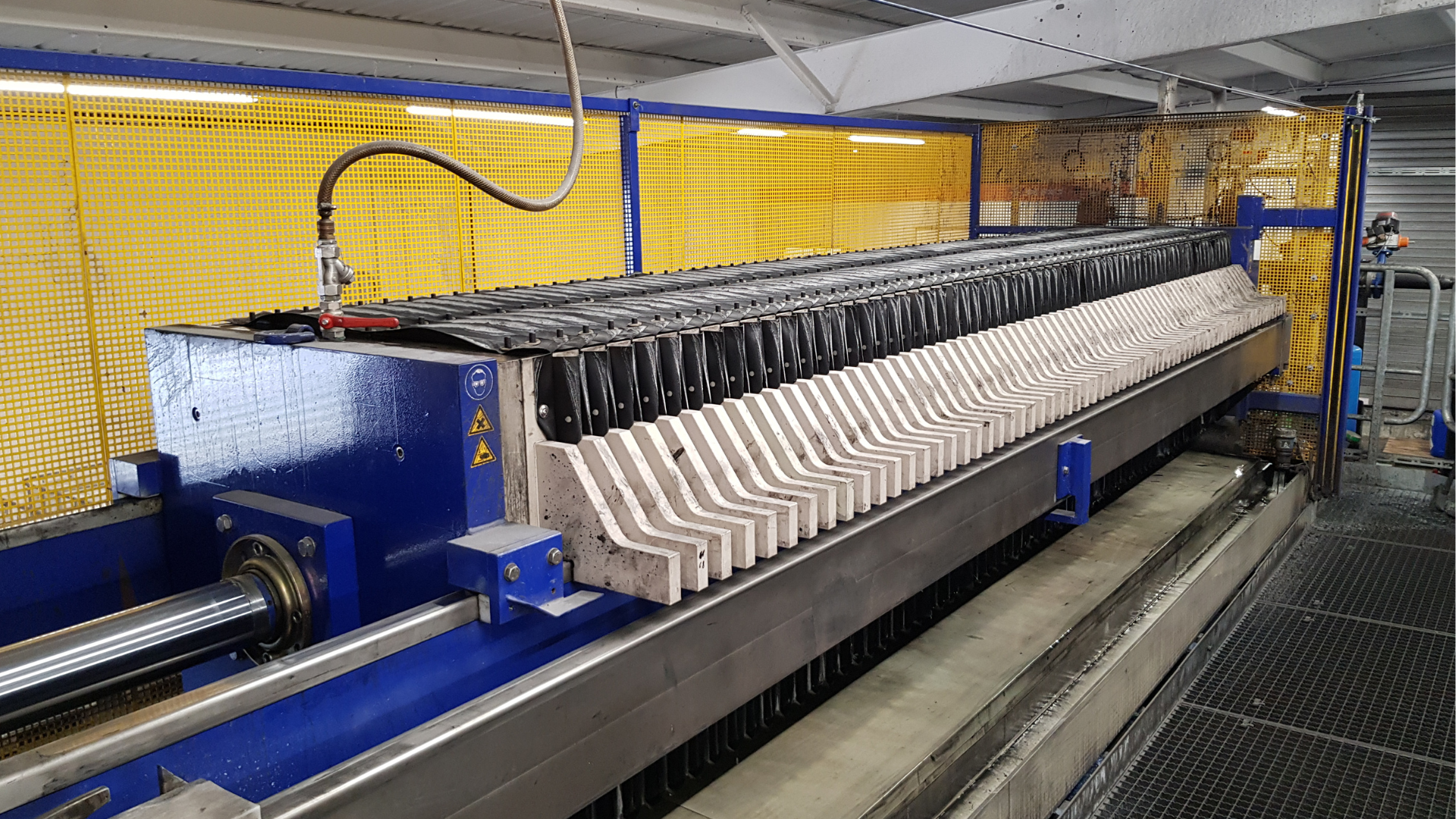
Photo: Our ALMA CFP chamber filter press for dewatering sludge from wastewater treatment plants
Evaluation of raw materials and residues
- The dry matter content is used to classify sludge and residues, especially for recycling or disposal:
- Biogas production:
- The dry matter content is crucial for dosing substrates and determining the gas yield.
- Combustion:
- A high dry matter content reduces the energy required for drying before thermal utilization.
- Biogas production:
Dimensioning of systems
- The design of pumps, tanks and pipelines depends heavily on the dry matter content:
- Niedriger TS-Gehalt (< 5 %): Schlammeigenschaften ähneln Flüssigkeiten; Transport mittels Kreiselpumpen.
- Medium dry matter content (5-15 %): Pump properties change; special progressive cavity pumps required.
- High dry matter content (> 15 %): Solids handling is required; conveyor systems such as screw conveyors or belt conveyors.
Environmental requirements
- The dry matter content is a relevant parameter for compliance with legal requirements:
- Sewage Sludge Ordinance:
- Definition of limit values for the dry matter in sewage sludge that is suitable for agricultural use.
- Disposal of residues:
- Minimum requirements for the dry matter content before landfilling or recycling.
- Sewage Sludge Ordinance:
Process for increasing the dry matter content
1. drainage process
- Objective: Reduction of the water content and increase of the dry matter content.
- Mechanical processes:
- Centrifuges: High dewatering performance, dry matter content of 20-30 % achievable.
- Chamber filter pressesMaximum dewatering with dry matter values of up to 40 %.
- Belt presses: Suitable for large volume flows, TS values between 15 and 25 %.
- Thermal processes:
- Direct drying (e.g. drum dryer) to achieve dry matter values > 90 %.
2. compaction technologies
- Screw presses: Mechanical reduction of the water content through compaction.
- Hydrocyclones: Separation of solids and liquids by centrifugal force.
3. sludge conditioning
- Flocculant:
- Addition of polymers or coagulants (e.g. iron or aluminum salts) to improve drainability.
- Lime stabilization:
- Addition of quicklime (CaO) or hydrated lime (Ca(OH)2) to bind water and stabilize the sludge.
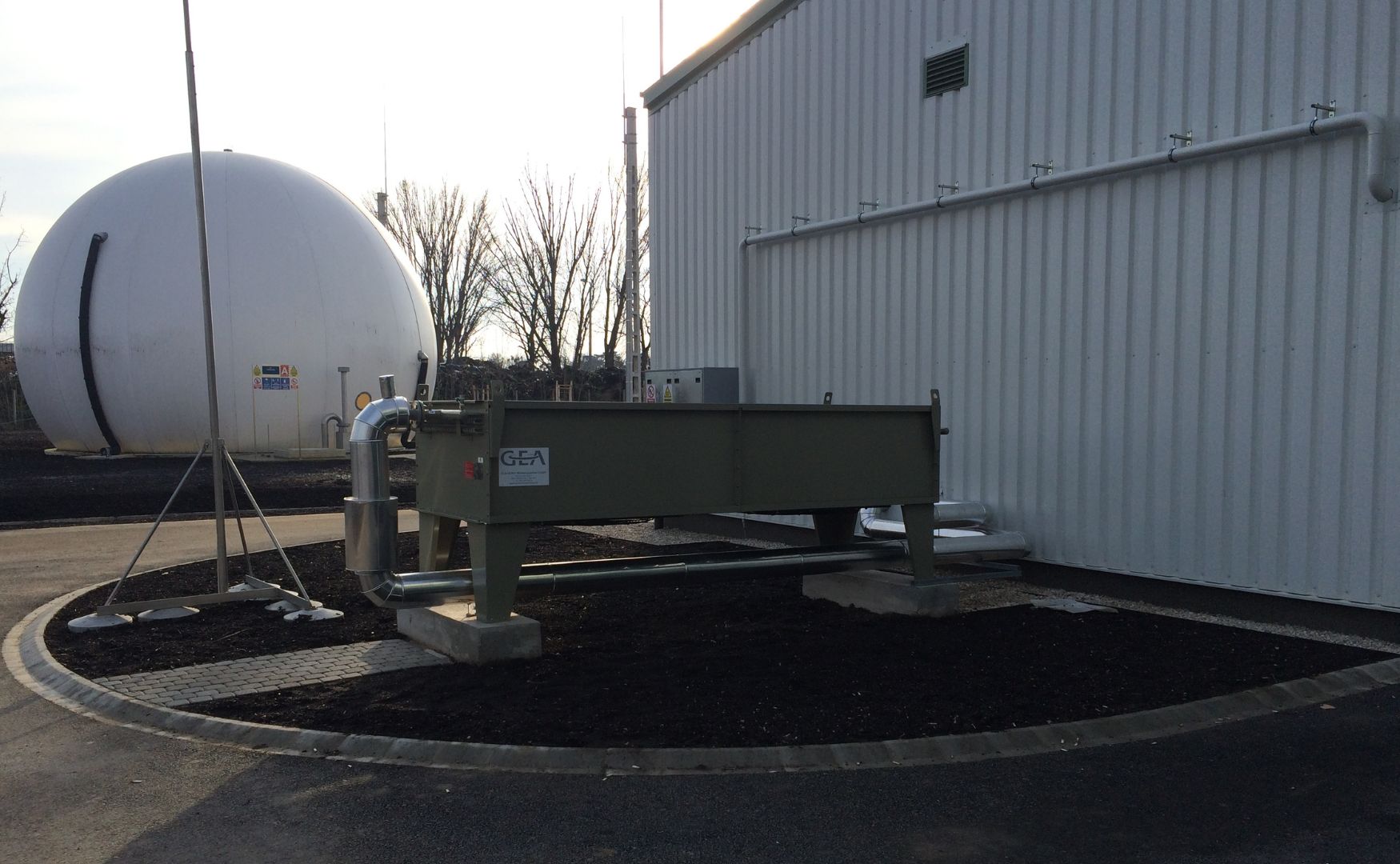
Photo: Decanter centrifuge for dewatering sludge from our anaerobic biogas plant ALMA BHU GMR
Advantages of controlling the dry matter content
Increased efficiency:
- Optimized processes in sludge treatment and water treatment.
- Reduced energy consumption in thermal recycling processes.
Cost reduction:
- Minimization of transport and disposal costs due to lower water weight.
Environmental benefits:
- Reduction of the volume and mass of residues that have to be disposed of or recycled.
Conclusion
The dry matter content is an essential parameter in industrial water and wastewater technology. It not only serves as an indicator for the quality of sludge and residues, but is also the basis for process optimization and resource efficiency. Targeted control and adjustment of the dry matter content enables the efficient design of dewatering, transportation and recycling processes, which offers both economic and ecological benefits. By using modern technologies and chemical additives, plant operators can effectively control the dry matter content and sustainably optimize their processes.
For further information on our products, please feel free to contact us at any time!