
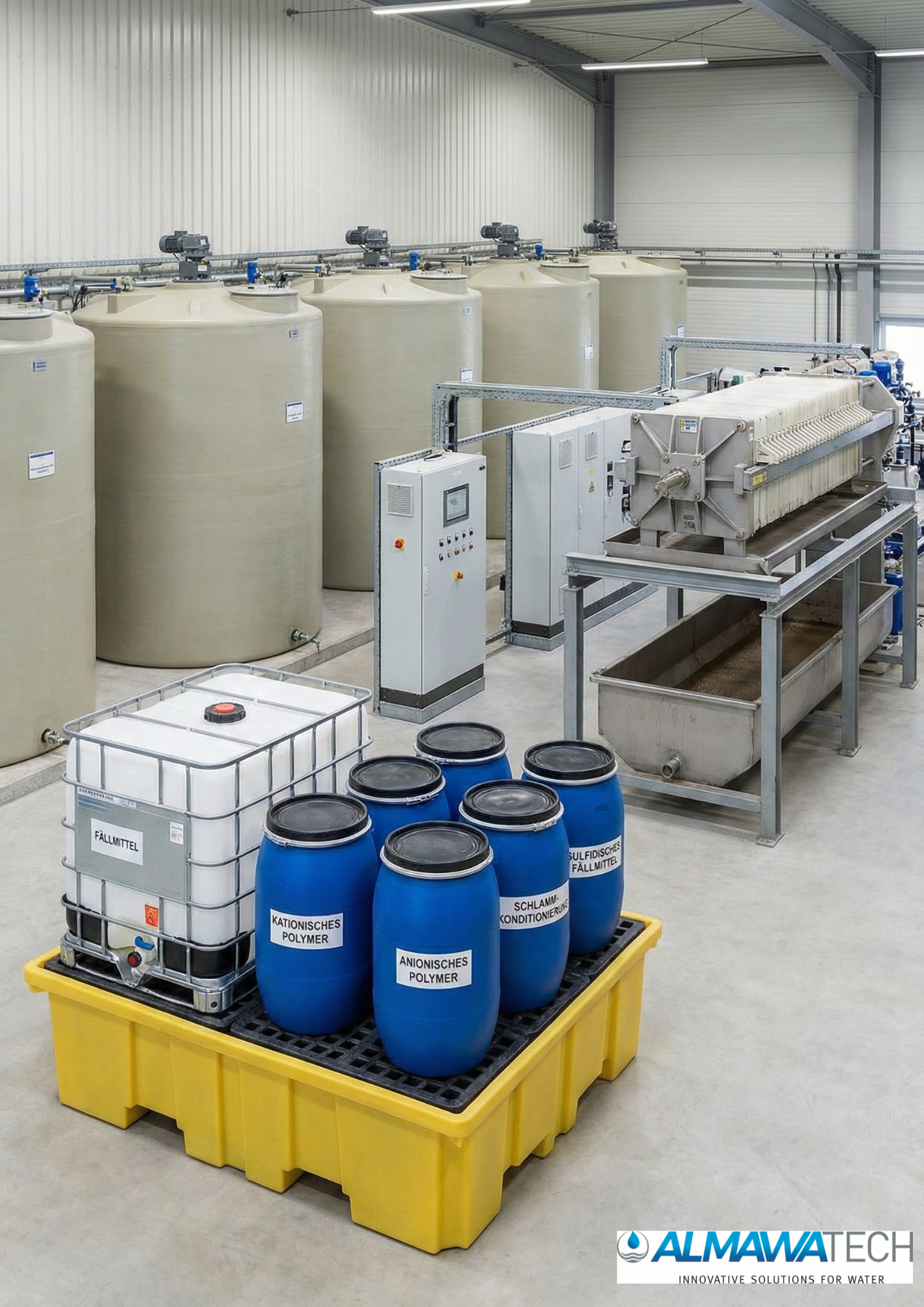
Precipitants & coagulants
We will be happy to help you choose the right coagulant/precipitant!

Frank Kuntze
Sales Manager Water and Process Additives
Why precipitants & coagulants are indispensable
Proof of Performance - Our references





Your advantages with ALMA AQUA dispersants
Service & technology - everything from a single source
Advice & system recording
Laboratory and practical tests
Online monitoring & software solutions
Integrated dosing and control technology
Automated additive replenishment
Evaluation & reporting
Formulations & compatibility
OEM & private label solutions
FAQ
What are precipitants and coagulants and how do they work?
Precipitants and coagulants are key process additives in industrial water and wastewater treatment, as they trigger both chemical reactions and physical processes to effectively remove pollutants.
Precipitants react directly with dissolved substances such as heavy metals, phosphates or carbonates and convert them into poorly soluble solids (e.g. metal hydroxides, calcium carbonates).
Coagulants neutralize the surface charge of colloidal particles and finely dispersed substances, causing them to combine to form larger, sedimentable flocs.
The combined use ensuresEffective metal precipitation in electroplating, metal processing and surface treatment
Phosphate precipitation in the food industry and municipal wastewater treatment plants
Pre-treatment in river water treatment to protect membranes and heat exchangers
AOX elimination in the chemical industry
The end result: Stable, clear water that meets the limit values and provides optimum protection for the plant technology.
What typical problems can be solved with precipitants and coagulants?
Precipitants and coagulants offer a solution for a variety of process and wastewater problems that often cannot be adequately treated mechanically or biologically:
Exceeding limit values for metals: E.g. nickel, zinc, copper, chromium, lead - particularly relevant for the metalworking industry, electroplating, automotive suppliers
High turbidity and suspended solids content: Separation of fine particles in river water treatment or cooling water pre-treatment
Color and COD loads: Removal of lignin-based dyes in the paper industry or dye residues in textile processing
Phosphate pollution: Compliance with P limits to avoid eutrophication
AOX elimination: Binding of organically bound halogens in the chemical industry and recycling processes
Fat and protein load: Pre-treatment of dairy wastewater before biological stage
How are precipitants and coagulants dosed?
Dosing is usually carried out continuously or as a shock addition, depending on the water quality and the process:
Continuous: Uniform dosing via a dosing pump, controlled according to flow rate, pH or turbidity
Impulse dosing: Short-term, targeted addition during peak loads or for special treatments
An optimum dosing point is usually located in front of a mixing tank or in a mixing section to ensure a fast and complete reaction.
What role do precipitants play in flotation?
In Dissolved Air Flotation (DAF ), precipitants are often the key to stable and rapid particle separation.
They are used in dairies to bind fats, proteins and fine solids and combine them into stable flakes that can be transported to the surface with air bubbles.
In the food industry, they enable a significant reduction in COD and grease, which reduces wastewater charges and relieves the biological stage.
In metal processing, they help to efficiently remove finely dispersed metal particles and hydroxides from wastewater.
An optimized insert ensures higher separation efficiency, lower chemical consumption and stable clear water quality, even with fluctuating inlet loads.
How do precipitants contribute to heavy metal removal?
Precipitants are unbeatable in heavy metal precipitation, as they convert metals into poorly soluble, filterable solids:
Chemical mechanism: Metals such as nickel, zinc, copper or chromium react with the precipitant to form metal hydroxides, carbonates or sulphides, which have extremely low residual solubilities.
Practical application: In electroplating, they are often used in multi-stage precipitation processes to get from mg/l to the µg/l range.
Process integration: The floc size is optimized through targeted pH control and the use of suitable coagulants, which facilitates separation in sedimentation tanks or filters.
Advantage: Compliance with the strictest discharge limits with simultaneous sludge optimization for cost-effective disposal.
What is the significance of precipitants in river water treatment?
Precipitants are used in the treatment of raw water from rivers:
Remove suspended solids and reduce turbidity
Decarbonization through precipitation of calcium and magnesium salts
Protection of downstream membrane systems or boiler systems against deposits
This is particularly important in the energy and industrial supply sectors in order to extend system running times and reduce maintenance costs.
What regulatory aspects need to be considered for dispersants?
The use of dispersants affects chemicals legislation, water protection, occupational safety and industry-specific regulations. An overview of the most important points - plus a practical checklist:
Chemicals law & occupational safety
REACH: Only use substances/formulations that are registered under REACH; observe exposure scenarios (especially for professional/industrial use).
CLP: Keep the current version of the classification/labeling (hazard pictograms, H-/P-phrases) and safety data sheet (SDS) available.
Hazardous Substances Ordinance / TRGS 510: Storage according to hazard classes (e.g. separate storage, ventilation), operating instructions and instructions for employees.
WGK / AwSV: Check water hazard class (WGK); if necessary, operate storage containers in retention basins (collecting chambers), regular leakage checks.
Water protection & discharge
Wastewater Ordinance (AbwV): Only discharge wastewater from flushing/blowdown if the limit values (e.g. COD, AOX, metals) are complied with; if necessary, provide for neutralization/pre-treatment.
Permit requirement: In the case of indirect discharge (sewer), coordinate with the disposal company/municipal authority; in the case of direct discharge (water), strictly comply with official notices.
Sludge & waste: If necessary, dispose of sludge/solids from filtration in accordance with waste legislation (declaration, verification).
Plant & industry rules
VDI 2047 Sheet 2 / 42nd BImSchV (evaporative cooling systems, wet separators): Use of chemicals (incl. dispersants) must match the hygiene management; keep biocide/operation logs, document germ monitoring.
VDI 6044 / VDI 2035 (closed circuits/heating and boiler water): Disperser must conform to material and standards (conductivity, pH, corrosion/coating risks).
Membrane systems: Observe manufacturer's approvals (material compatibility of RO/NF/UF membranes, pH window, maximum permissible concentrations) - otherwise there is a risk of loss of warranty.
Food/pharmaceuticals: Only use suitable, approved formulations in indirect contact zones (e.g. cooling/heating media without product contact); comply with hygiene and audit specifications (HACCP, GMP).
Power plants & energy: Observe specifications from PED (pressure equipment), operator regulations and, if applicable, TA Luft/WHG (e.g. for evaporators/desalination systems).
Documentation & monitoring
Maintain product specifications/SDS/TDB; document proof of compatibility (with inhibitors, biocides, antiscalants).
Operating log: Record dosing quantities, concentrations, measured values (turbidity, ΔT, differential pressure), events (cleaning/flushing).
Effect/influence control: Regular laboratory & online measurements (turbidity/particles, conductivity, pH, AOX/CSB if necessary), evaluate corrosion coupons/heat exchanger performance data.
Practical checklist before use
Check approvals: REACH/CLP, SDS, WGK, membrane/plant manufacturer.
Process test: laboratory jar test & on-site pilot (compatibility with biocide/inhibitor).
Clarify discharge: AbwV limits, internal/regulatory requirements, separator/neutralization.
Storage & emergency plan: AwSV-compliant storage, containment volume, leakage/spill kit, instruction.
Define monitoring & reporting: Key figures, intervals, responsibilities.
This approach ensures that the use of the disperser is legally compliant, audit-proof and reliable - and that process performance increases measurably at the same time.
Can precipitants remove AOX from wastewater?
Yes - precipitants can reliably reduce AOX (adsorbable organically bound halogens) in many industrial wastewaters.
Operating principle: Special precipitants bind AOX-containing molecular compounds to their floc structure so that they are discharged with the sludge.
Typical areas of application: Chemical industry, paper and pulp production, surface treatment
Benefit: Ensuring compliance with AOX limit values in accordance with the Wastewater Ordinance and industry-specific regulations (e.g. AbwV, EU directives).
Process advantage: AOX elimination can often be integrated into existing precipitation/flocculation stages without having to invest in separate systems.
How do I find the optimum precipitant for my process?
The selection of the correct precipitant or coagulant is process-specific and should always be based on a sound analysis. We recommend the following procedure:
Water analysis - determination of raw water or wastewater parameters (metal content, phosphates, AOX, turbidity, pH, conductivity, complexing agents, salt content).
Process-related framework conditions - clarification of whether the water is treated in flotation, sedimentation, filtration, membrane processes or a combination of these.
Target values and regulation - definition of the limit values to be complied with (wastewater ordinance, industry-specific standards, internal quality specifications, zero liquid discharge requirements if applicable).
Test phase - Carry out jar tests in the laboratory or pilot tests under real conditions to determine the optimum dosing quantity, pH range and possible coagulant combinations.
Long-term optimization - Continuous monitoring of efficiency, chemical consumption and sludge volume for further process improvement.
Our service advantage: You can send us water samples at any time. In our technical center, we determine the optimum precipitant and coagulant combinations for you free of charge - precisely tailored to your process conditions and your target values. You will then receive a clear product recommendation with dosing instructions and possible optimization suggestions.
How can precipitants be optimized for selective metal removal from complex-forming wastewater?
Complexing agents such as EDTA, ammonia or cyanides bind metals so strongly that standard precipitants are often not sufficient to achieve the limit values. In such cases, selective special precipitants are required that react specifically with metal ions without unnecessarily affecting the rest of the water chemistry.
Successful optimization includes
Pre-treatment steps (e.g. pH adjustment, oxidation, reduction) to break down complexes
Selection of the right precipitant with a high affinity to the target metals
Dosing optimization based on jar tests under realistic process conditions
Combination with high-performance coagulants to efficiently separate even fine particles
In the metalworking and electroplating industries in particular, such customized solutions are often the key to reliably complying with µg/l limit values.
Which process strategy is optimal for the integration of precipitants in DAF systems?
In Dissolved Air Flotation (DAF) systems, the success of particle and grease separation depends heavily on the chemical pre-treatment. Precipitants and coagulants should be used in such a way that:
Flakes with optimum density and strength are produced, which adhere well to air bubbles
The contact time between the addition of chemicals and the air saturation stage is precisely coordinated
Avoid overdosing, as this leads to unstable flakes or high chemical consumption
In dairies and the food industry in particular, a finely tuned precipitant strategy can drastically reduce the fat and COD values in the clear water - and thus reduce wastewater charges and operating costs.
How can precipitant processes be controlled automatically with fluctuating raw water quality?
In applications such as river water treatment or with seasonally varying raw water sources, turbidity, hardness and metal content often fluctuate greatly. A dynamic dosing strategy can be decisive here:
Use of online sensors for turbidity, pH, conductivity or metal ions
Control algorithms in the dosing control system that automatically adjust the chemical quantities
Multi-stage precipitation/flocculation sections to absorb peak loads
Integration with digital monitoring and evaluation systems for precise process control
This approach is particularly important in energy supply, power plant water treatment and large-scale plants in order to ensure both operational safety and compliance.
Need technical advice? Inquire now!
Frank Kuntze
Sales Manager Water and Process Additives