

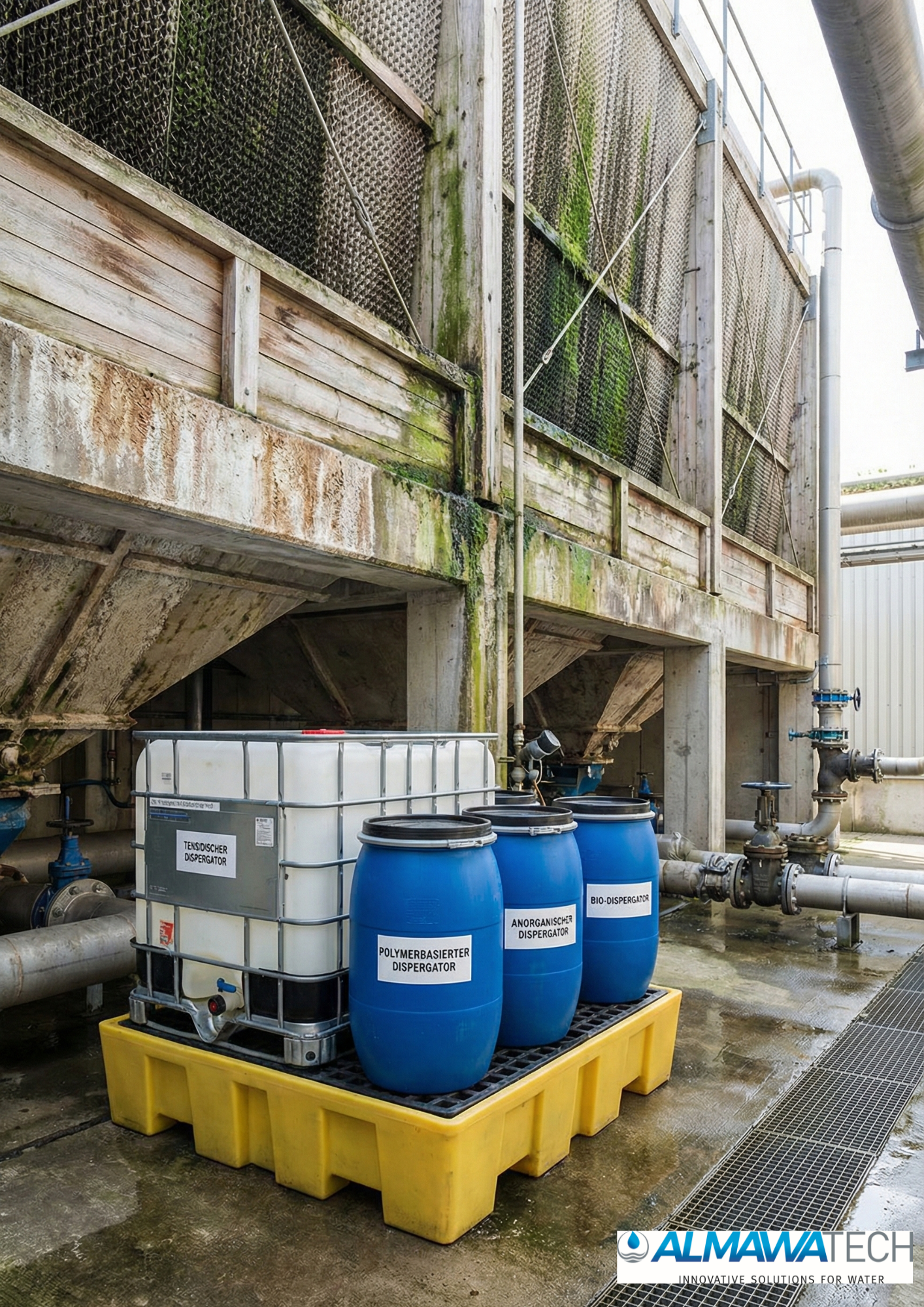
High-performance dispersers for every process
Getting to grips with deposits? We can help!

Frank Kuntze
Sales Manager Water and Process Additives
Why dispersants are indispensable
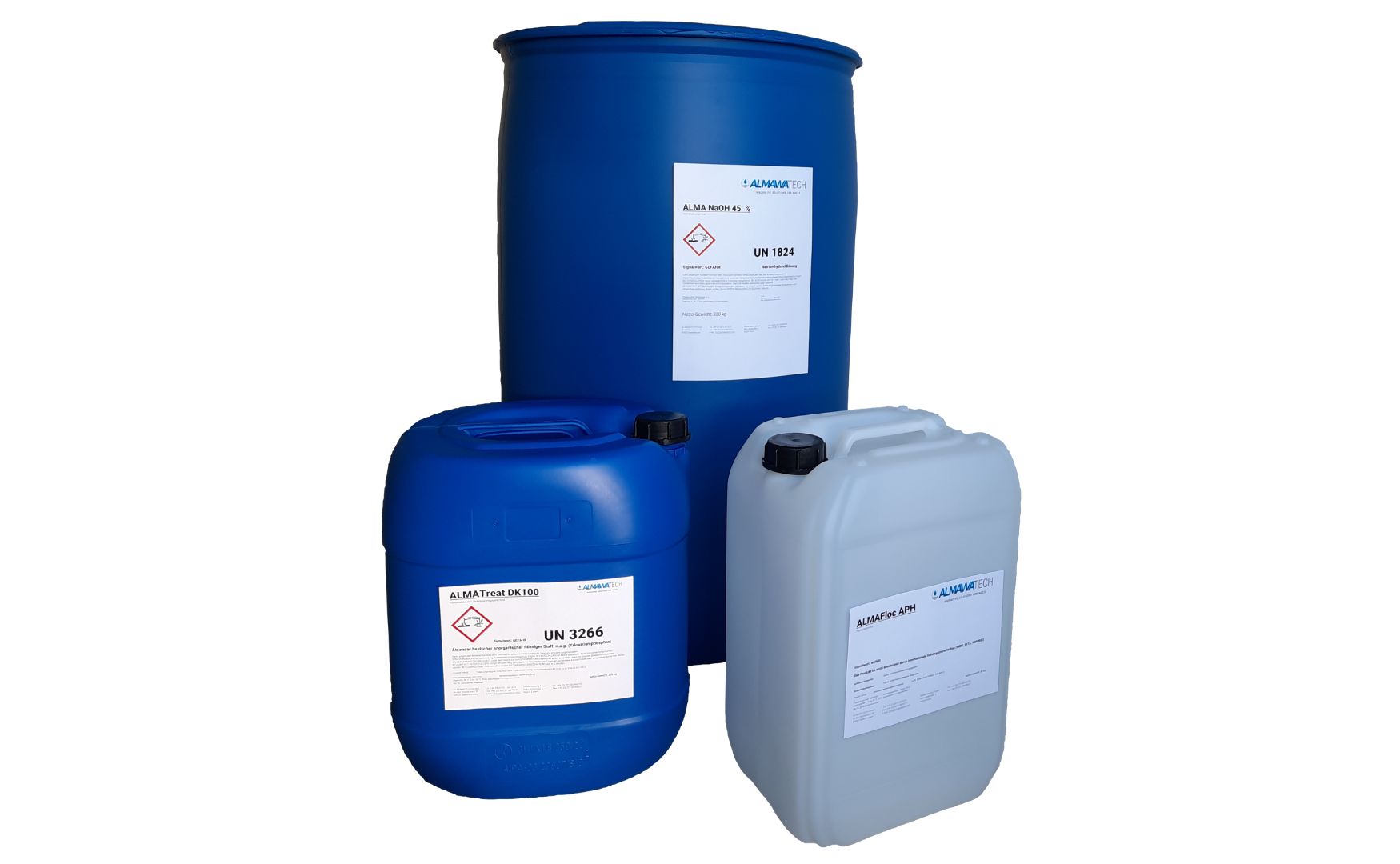
Proof of Performance - Our references






Your advantages with ALMA AQUA dispersants
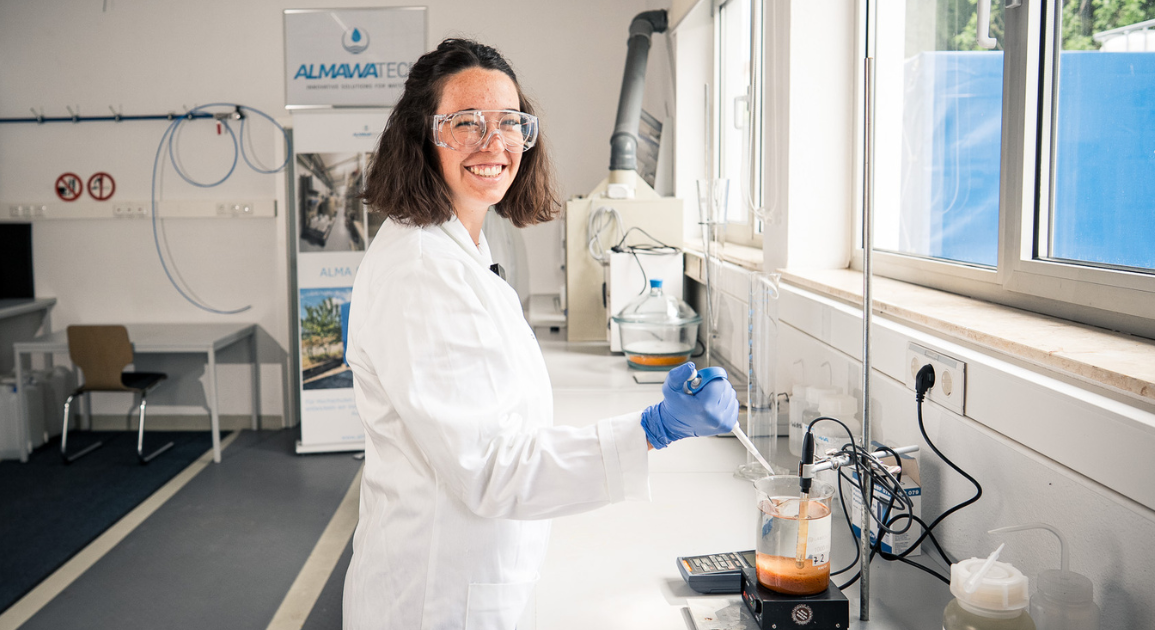
Service & technology - everything from a single source
Advice & system recording
Laboratory and practical tests
Online monitoring & software solutions
Integrated dosing and control technology
Automated additive replenishment
Evaluation & reporting
Formulations & compatibility
OEM & private label solutions
FAQ
What are dispersants and how do they work?
Dispersants are special process additives that prevent solids, sludge flocs, mineral particles or biofilm components from causing deposits in industrial water systems.
They work according to the principle of particle stabilization:
Surface modification: Dispersants attach themselves to particle surfaces and change their charge (zeta potential) so that particles repel each other.
Steric stabilization: Longer polymer chains act as spacers and prevent particles from coming into contact.
Crystal growth inhibition: Some formulations bind to growing crystals, interrupting the growth process and keeping them at microscopic size.
Practical benefits:
Deposits on heat exchangers are avoided
Biocides can work more effectively because biofilm does not become so compact
Membrane processes remain stable for longer as fouling is reduced
Where are dispersants typically used?
Dispersants can be used universally, but are primarily used in the following applications:
Open cooling water systems: Prevent deposits of suspended matter, dust, rust particles and biofilm residues
Closed heating and cooling systems: Stabilize corrosion products and prevent sludge deposits in heat exchangers
Reverse osmosis and nanofiltration systems: Reduce particle fouling and extend the time intervals between membrane cleanings
Waste water treatment: Stabilize solids in clear water, prevent precipitation before filters
Paper, pulp and recycling industry: Prevents deposits from fillers, fibers and mineral components
Chemical and pharmaceutical industry: Control particle and crystal formation in complex process waters
What is the difference between dispersants and antiscalants?
Antiscalants and dispersants have different focuses, even if their mechanisms of action partly overlap:
Antiscalants:
Primarily inhibit the precipitation and crystallization of dissolved salts
Often work at very low concentrations due to the threshold effect
Typical target deposits: Calcium carbonate, calcium sulphate, barium and strontium sulphate
Dispersants:
Stabilize existing solid particles in suspension
Prevent these particles from combining or settling into larger agglomerates
Suitable for mineral solids, corrosion products, biofilm residues
Combination in practice:
In cooling water systems or membrane processes in particular, both additive types are combined to control both crystalline and particulate deposits at the same time.
What is the "threshold effect" and does it play a role in dispersants?
The threshold effect describes the ability of certain additives to prevent precipitation even at extremely low dosages - well below the stoichiometrically required amount.
The effect is less pronounced with dispersants than with antiscalants, as they are primarily designed to stabilize particles and not to directly inhibit crystal growth.
Nevertheless, phosphonate- or polymer-based dispersants can combine both effects in hybrid formulations.
What advantages do ALMA AQUA dispersants offer compared to standard products?
Special formulations depending on the application: cooling water, membrane, waste water, high-temperature circuits
High temperature and pH resistance, even in highly alkaline or acidic processes
Long-term stability - the dispersing effect is maintained even at high solids concentrations
Optimized molecular structure for maximum adsorption on particles and effective stabilization
Synergies with other additives such as corrosion inhibitors or biocides
Individual dosing concepts after laboratory analysis and on-site testing
OEM and private label options with customized container sizes and labels
Which dosing points are optimal for dispersants?
The dosing point is decisive for efficiency:
Open cooling circuits: In the main flow, if possible upstream of a strong turbulence zone or mixing section
Membrane systems: Before the safety filter (cartridge filter), so that all solids are stabilized before they reach the membrane
Wastewater treatment: Before fine filtration or before a downstream membrane module
Closed systems: In front of circulation pumps or at points with high flow velocity
Practical tip:
Dosing too late can cause particles to precipitate or settle before they are added - which significantly reduces their effectiveness.
What regulatory aspects need to be considered for dispersants?
The use of dispersants affects chemicals legislation, water protection, occupational safety and industry-specific regulations. An overview of the most important points - plus a practical checklist:
Chemicals law & occupational safety
REACH: Only use substances/formulations that are registered under REACH; observe exposure scenarios (especially for professional/industrial use).
CLP: Keep the current version of the classification/labeling (hazard pictograms, H-/P-phrases) and safety data sheet (SDS) available.
Hazardous Substances Ordinance / TRGS 510: Storage according to hazard classes (e.g. separate storage, ventilation), operating instructions and instructions for employees.
WGK / AwSV: Check water hazard class (WGK); if necessary, operate storage containers in retention basins (collecting chambers), regular leakage checks.
Water protection & discharge
Wastewater Ordinance (AbwV): Only discharge wastewater from flushing/blowdown if the limit values (e.g. COD, AOX, metals) are complied with; if necessary, provide for neutralization/pre-treatment.
Permit requirement: In the case of indirect discharge (sewer), coordinate with the disposal company/municipal authority; in the case of direct discharge (water), strictly comply with official notices.
Sludge & waste: If necessary, dispose of sludge/solids from filtration in accordance with waste legislation (declaration, verification).
Plant & industry rules
VDI 2047 Sheet 2 / 42nd BImSchV (evaporative cooling systems, wet separators): Use of chemicals (incl. dispersants) must match the hygiene management; keep biocide/operation logs, document germ monitoring.
VDI 6044 / VDI 2035 (closed circuits/heating and boiler water): Disperser must conform to material and standards (conductivity, pH, corrosion/coating risks).
Membrane systems: Observe manufacturer's approvals (material compatibility of RO/NF/UF membranes, pH window, maximum permissible concentrations) - otherwise there is a risk of loss of warranty.
Food/pharmaceuticals: Only use suitable, approved formulations in indirect contact zones (e.g. cooling/heating media without product contact); comply with hygiene and audit specifications (HACCP, GMP).
Power plants & energy: Observe specifications from PED (pressure equipment), operator regulations and, if applicable, TA Luft/WHG (e.g. for evaporators/desalination systems).
Documentation & monitoring
Maintain product specifications/SDS/TDB; document proof of compatibility (with inhibitors, biocides, antiscalants).
Operating log: Record dosing quantities, concentrations, measured values (turbidity, ΔT, differential pressure), events (cleaning/flushing).
Effect/influence control: Regular laboratory & online measurements (turbidity/particles, conductivity, pH, AOX/CSB if necessary), evaluate corrosion coupons/heat exchanger performance data.
Practical checklist before use
Check approvals: REACH/CLP, SDS, WGK, membrane/plant manufacturer.
Process test: laboratory jar test & on-site pilot (compatibility with biocide/inhibitor).
Clarify discharge: AbwV limits, internal/regulatory requirements, separator/neutralization.
Storage & emergency plan: AwSV-compliant storage, containment volume, leakage/spill kit, instruction.
Define monitoring & reporting: Key figures, intervals, responsibilities.
This approach ensures that the use of the disperser is legally compliant, audit-proof and reliable - and that process performance increases measurably at the same time.
Can dispersants be combined with other water treatment chemicals?
Yes - ALMA AQUA dispersants are developed to be formulation compatible with:
Corrosion inhibitors: Prevent underlayment corrosion under solid layers
Biocides: Dispersants loosen up biofilm structures and increase the biocidal effect
Hardness stabilizers / antiscalants: Simultaneous protection against crystalline and particulate deposits
Precipitants: In some cases, dispersants can be specifically dosed so that solids remain stable up to the desired precipitation point
Attention: Certain strongly cationic and anionic polymers can precipitate each other - therefore always carry out compatibility tests.
How is the optimum dosing quantity determined?
The dosing quantity depends on several factors:
Solids load: The higher the particle concentration, the more dispersant is required
Chemical water composition: hardness, pH, ionic strength influence adsorption on the particle
Process temperature: High temperatures can affect molecular stability
Target application: Cooling water, membrane systems or waste water treatment require different dosing ranges
Best practice at ALMA AQUA:
Laboratory testing: particle size analysis, zeta potential measurement
Jar test: simulation of the water chemistry and optimization of the dosing quantity
On-site test with monitoring of turbidity, deposition rate and heat transfer performance
What are hybrid dispersers and when are they useful?
Hybrid dispersants combine classic dispersants with antiscalants or corrosion inhibitors in a single formulation.
They offer the advantage that particulate deposits (e.g. sludge, rust particles, biofilm residues) and crystalline precipitates (e.g. calcium carbonate, calcium sulphate) can be controlled simultaneously.
Areas of application: Cooling circuits with high suspended solids load and hardness problems, membrane pre-treatment with mixed fouling types.
Technical benefits: Reduced variety of chemicals, less dosing technology, simplified storage.
Caution: Not every system tolerates mixed formulations - always carry out laboratory and on-site tests beforehand to rule out interactions.
How does the combination of dispersants and biocides influence biofilm control?
Biofilms are often multi-layered structures consisting of microorganisms, EPS (extracellular polymeric substances) and embedded particles.
dispersants:
Loosen up the EPS matrix by destabilizing particle bonds
Mechanically weaken biofilm structures so that biocides penetrate deeper
Remove particulate protective layers that otherwise block biocides
Practical recommendation:
Dosing dispersants before or parallel to the addition of biocides
Use specifically for shock disinfection to maximize the biocidal effect
Perform monitoring via biofilm measurement (ATP, pressure loss, heat exchanger ΔT)
This interaction can reduce biocide dosing and significantly increase system efficiency.
How do you optimize dispersant dosing with fluctuating solids loads?
In many industrial systems, the solids concentration fluctuates greatly - e.g. in cooling water systems in summer/winter, during production peaks or with changing raw water quality.
Optimization strategies:
Online turbidity measurement (NTU) or particle counter for real-time monitoring of the solids load
Load-dependent dosing with flow or turbidity control
Temporary surge dosing for recognizable load peaks
Combination with blow-off/rinse management for active solids removal
Regular laboratory analyses (particle size distribution, mineral analysis) to adjust the basic dosage
This prevents over- or underdosing, optimizes chemical consumption and at the same time maintains a consistently high level of deposit protection.
Need technical advice? Inquire now!
Frank Kuntze
Sales Manager Water and Process Additives