


Targeted micronutrient supply
Optimize biological clarification stage? We can help!

Frank Kuntze
Sales Manager Water and Process Additives
Why nutrient and trace element dosing is important
Proof of Performance - Our references






Your benefits with ALMA AQUA cleaning agents
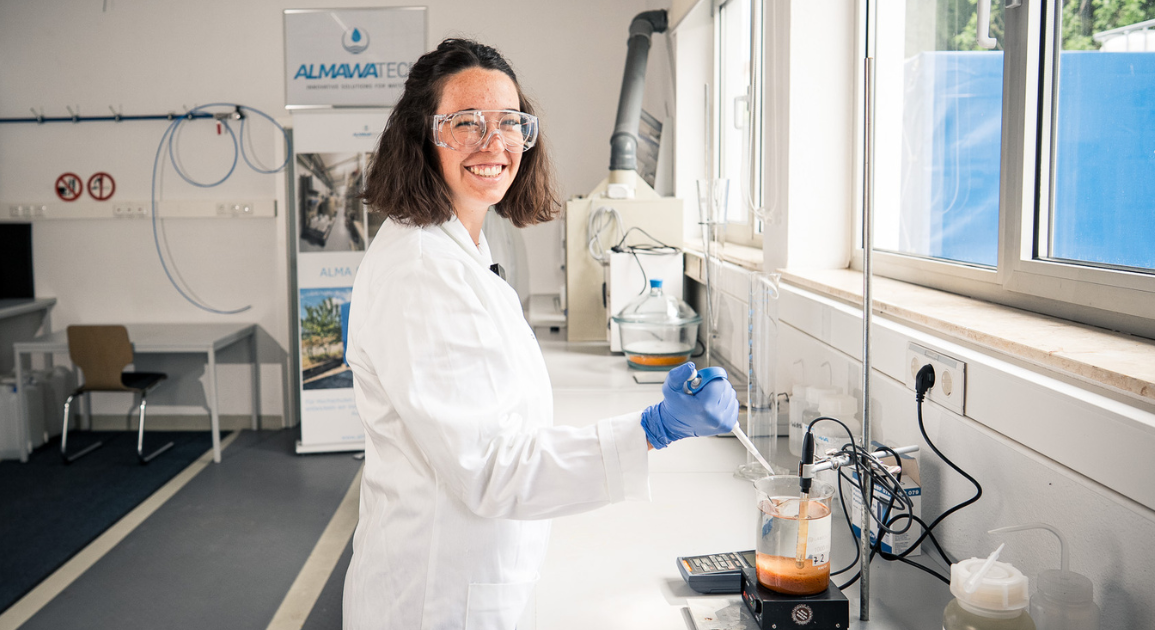
Service & technology - everything from a single source
Advice & system recording
Laboratory analysis of the nutrient balance
Online monitoring & software solutions
Integrated dosing and control technology
Automated additive replenishment
Evaluation & reporting
Formulations & compatibility
OEM & private label solutions
FAQ
Why are nutrients and trace elements so important in biological wastewater treatment plants?
In biological wastewater treatment, microorganisms - bacteria, fungi, protozoa - perform the main work of breaking down organic and inorganic pollutants.
Three key requirements must be met for these organisms to work optimally:
Energy source (organic substances, e.g. carbohydrates, fats, proteins)
Macronutrients (nitrogen, phosphorus, potassium) for building cell structures
Trace elements (e.g. iron, copper, zinc, cobalt, molybdenum) for enzymatic metabolic reactions
If just one of these components is missing, the metabolic chain of the microbes can be interrupted - comparable to a production line in which a missing component stops the entire production process.
The results are:
Lower COD and BOD₅ degradation
Unstable process values (pH, dissolved oxygen, redox potential)
Visible operating problems such as foaming, flake decay or filament growth
Practical example:
In a dairy wastewater treatment plant, a lack of phosphorus led to unstable nitrification and increased ammonium in the effluent despite a high COD load. Nitrification was only restored within 48 hours after the targeted addition of an ALMA AQUA nutrient mix.
How can I recognize a nutrient or trace element deficiency in my system?
A defect can be detected both directly through laboratory analyses and indirectly through process observations.
Typical indicators in operation:
Chemical-analytical:
Elevated discharge values for COD, BOD₅, ammonium or nitrate
Unfavorable N/P ratio in the inlet
Very low concentrations of certain metals (Fe, Cu, Co, Mo) in the sludge phase
Process biology:
Reduced oxygen uptake rate (OUR)
Extended start-up times after peak loads
Lower gas production in anaerobic plants
Visual cues:
Foaming or unstable sludge flakes
Filamentous sludge (filamentous bacteria)
Dark or very light sludge coloration (false colonization)
Practical tip:
A microscopic examination in combination with a nutrient balance is the safest way to detect a deficiency at an early stage - before limit values are exceeded.
How is the correct nutrient requirement determined?
This is determined by means of a nutrient balance:
Analysis of the inflow values (COD, BOD₅, total N, total P, trace element content)
Calculation of the N/P ratio - for aerobically operated systems, the ideal value is usually approx. 100:5:1 (COD:N:P)
Process monitoring - reaction times, degree of degradation, sludge properties
Laboratory tests with targeted addition of nutrients for efficacy testing
Tip: ALMA AQUA offers a complete nutrient analysis including dosing recommendations for every system size.
Which trace elements are particularly critical for the process?
Key elements for stable biological water and wastewater treatment:
Iron (Fe):
Involved in electron transport in the respiratory chain
Important for the formation of stable flake structures
If iron is missing, flocs disintegrate and the settling properties deteriorate
Copper (Cu):
Activates oxidation and reduction enzymes
Important for denitrifying bacteria
However, overdosing can have a toxic effect
Cobalt (Co):
Essential for vitamin B₁₂ synthesis in methanogens
Particularly critical in anaerobic processes, e.g. biogas plants
Zinc (Zn):
Co-factor of numerous enzymes
Supports cell wall and membrane stability
Molybdenum (Mo):
Necessary for nitrification and nitrate reduction
Deficiency leads to nitrogen degradation problems
Practical example:
In an industrial wastewater treatment plant in the chemical industry, a lack of cobalt and nickel led to a drastic drop in biogas production. After adding an ALMA AQUA trace element mix, the methane yield was increased by 30 %.
What are the risks of an overdose?
An overdose can be just as problematic as a deficiency - only less obvious.
Possible risks:
Increased operating costs due to unnecessary chemical consumption
Precipitation of nutrients in the effluent → Exceeding the limit values for total N or total P
Toxic effects on sensitive microorganisms with trace elements such as copper, nickel or zinc
Secondary effects:
Formation of interfering solids (e.g. iron phosphate sludge)
Inhibition of certain metabolic pathways (e.g. nitrification)
Prevention:
Automated dosing systems with flow or load-dependent control
Regular monitoring of the concentrations in the reactor and outlet
Combination with process monitoring (OUR measurement, microscopy, nutrient balance)
How are nutrients and trace elements dosed?
ontinuous dosing: via a dosing pump directly into the inlet or aeration tank
Impulse dosing: For acute deficiency states or process disorders
Multi-point dosing: For large systems or several reactor lines
We offer complete dosing systems with storage tanks, controls and remote monitoring.
Are the products suitable for all biological processes?
Yes - ALMA AQUA nutrients and trace elements are formulated to be widely applicable and process compatible:
Aerobic processes:
Activated sludge (conventional)
Membrane bioreactors (MBR)
Trickling filter systems
Anaerobic processes:
Digestion (municipal & industrial)
UASB/EGSB reactors
Co-fermentation in biogas plants
Combined procedures:
Nitrification / denitrification
Sequencing Batch Reactors (SBR)
Important:
The exact composition (macronutrients, trace elements, chelates) is adapted to the process type, the wastewater characteristics and the load.
This ensures that the microorganisms are optimally supplied without burdening the process by overdosing.
How do I optimize the N/P ratio in my biological system?
The N/P ratio (ratio of nitrogen to phosphorus) is a key indicator of the nutrient supply in biological purification processes.
Standard values for aerobic processes: approx. 100:5:1 (COD:N:P)
Standard values for anaerobic processes: vary depending on the substrate, often lower P requirement
optimization strategy:
Analyze inlet characteristics - measurement of COD, total N, total P
Take daily and weekly fluctuations into account
Fine-tuning the dosing based on discharge values and microscopy results
Load-dependent control with automatic adjustment of nutrient addition
Practical example:
In a dairy wastewater treatment plant, precise adjustment of the N/P ratio from 100:3:0.8 to 100:5:1 increased the nitrification performance by 20 % and kept the ammonium values in the effluent permanently below 2 mg/l.
Which trace elements are particularly critical in anaerobic biogas plants?
Anaerobic processes - especially methane formation stages - react very sensitively to trace element deficiencies. These are particularly important:
Cobalt (Co): essential for vitamin B₁₂, indispensable for methanogens
Nickel (Ni): Co-factor for enzymes in methanogenesis
Selenium (Se): for enzymes in acetate degradation
Iron (Fe): Electron transport, hydrogen sulphide binding
Typical problems with deficiency:
Decrease in methane production
Increase in volatile fatty acids (VFA) → pH drop
Unstable gas quality (CO₂ increase)
Solution:
Targeted addition of ALMA AQUA trace element mixtures with chelated stabilization to prevent precipitation in the event of excess sulphide or carbonate.
How can I recognize a trace element deficiency at an early stage before the process becomes unstable?
Early detection is crucial in order to avoid process faults and limit value violations.
Recommended methods:
Regular laboratory analyses of biomass and water (total and dissolved trace elements)
Microscopic control: decline in species diversity, occurrence of filamentous bacteria or lack of protozoa
Online process monitoring: changes in gas production (anaerobic), OUR/respiration rate (aerobic)
Bioassays: Laboratory scale tests with targeted nutrient addition → Measure reaction speed
Practical tip:
Trace element deficiencies often occur first in sub-processes, e.g. inhibition of nitrification or reduced biogas yield. Continuous process data evaluation in combination with a proactive nutrient strategy prevents critical faults from occurring in the first place.
Need technical advice? Inquire now!
Frank Kuntze
Sales Manager Water and Process Additives