
Reliable management of boiler water systems
Contact our experts for individual advice on your boiler water systems.

Frank Kuntze
Sales Manager Water and Process Additives
Objectives of the treatment of boiler water systems
Proof of Performance - Our references



Your advantages with ALMA AQUA
Standards and guidelines
Process additives & service - everything from a single source
Advice & system recording
Target definition
Product recommendation & treatment concept
Dosing and monitoring concept
Sampling & detection
Evaluation & reporting
FAQ
Why is water treatment in boiler water systems so crucial - technically, economically and in terms of standards?
Boiler and steam generators operate at high temperatures and pressures. Even small deviations in water quality can have serious consequences. Without targeted conditioning, oxygen corrosion, scale formation or foaming problems occur, which impair the steam quality. The condensate pipes are also at risk from carbonic acid corrosion.
The consequences are not only of a technical nature, but also directly affect profitability:
Efficiency losses due to coatings on heating surfaces → increased fuel consumption
Unplanned downtime due to material damage and leaks
Increased operating costs due to cleaning, spare parts or emergency chemicals
There are also clear normative requirements:
EN 12952-12 (water tube boilers) and EN 12953-10 (shell boilers) define water qualities, limit values and test intervals
Manufacturers specify specific target values for conductivity, pH/alkalinity, phosphate, silicic acid and oxygen
Operators are obliged to take documented samples and provide evidence
This makes it clear that only a coordinated overall concept comprising raw water treatment, degassing, chemical treatment and monitoring ensures steam quality, energy efficiency and material protection.
Which process additives are used in boiler water systems - for what, how and where are they dosed?
The choice of additives depends on the raw water quality, boiler type and operating conditions. In practice, five main groups are used:
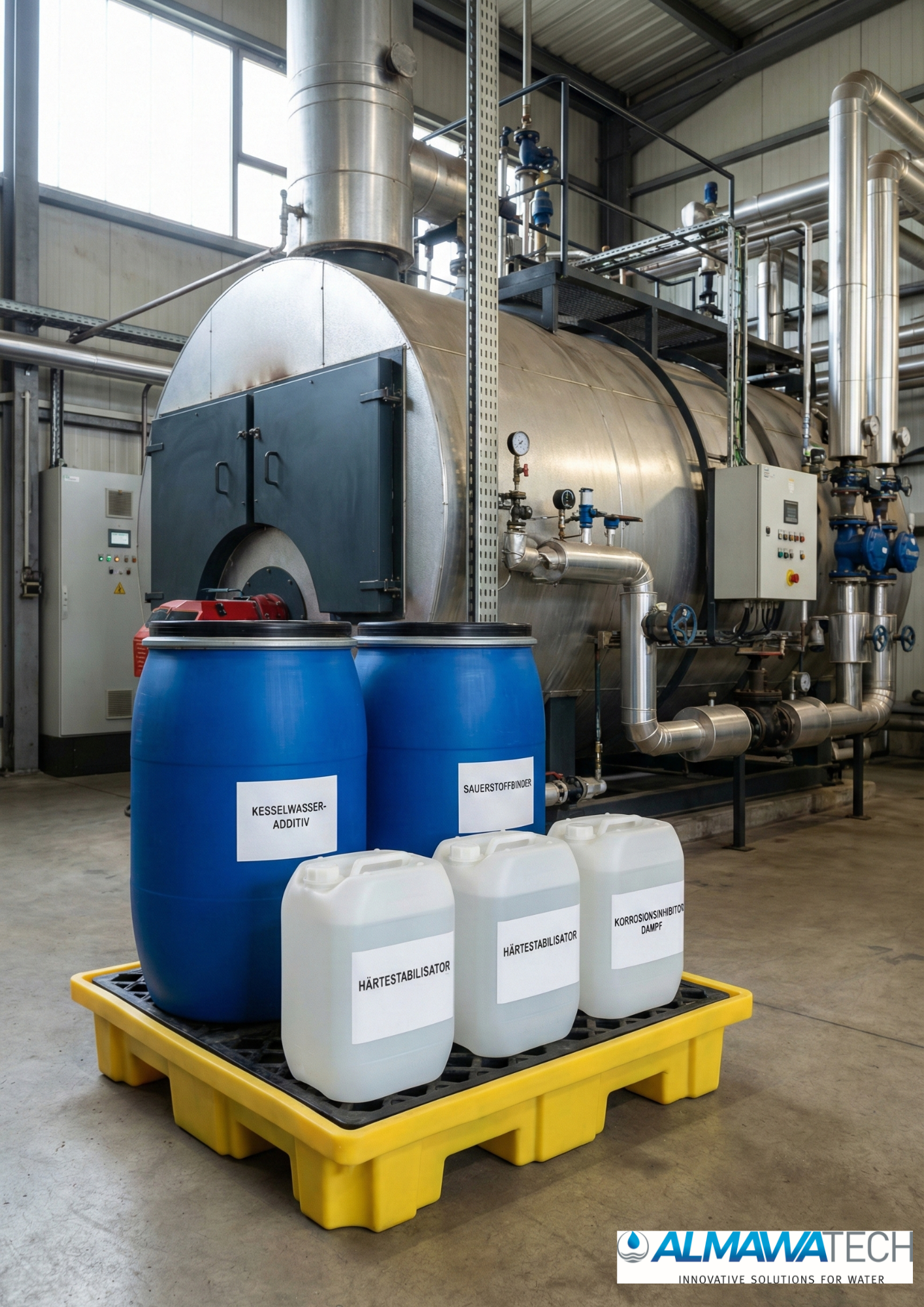
Oxygen binders (O₂ scavengers): Bind residual oxygen after degassing and prevent corrosion in feed and boiler water pipes. Typical are sulphite or modern carbohydrazide-based products with a passivating effect.
Hardness stabilizers and phosphate/polymer conditioning: They bind hardness formers and disperse particles so that no hard scale is formed. Polymers keep sludge in suspension, which is specifically removed via blowdown.
Alkalizing agents & pH buffers: They set the correct alkalinity, stabilize the phosphate program and minimize corrosion risks.
Defoamer: Prevents foam formation and thus ensures constant steam quality without carry-over.
Condensate treatment agents: Neutralizing amines raise the pH value in the condensate, while film-forming substances create hydrophobic protective layers on pipes.
The dosing strategy is crucial: additives must be added at the right points - typically in the feed line or directly in the boiler drum area. In addition, online measurements (conductivity, pH, oxygen) and laboratory analyses ensure the correct setting. Only through this combination can the system remain free of deposits and corrosion and meet the requirements of the standards.
How is standard-compliant monitoring, sampling and documentation carried out - and how does ALMA AQUA ensure compliance?
The compliant operation of a boiler water system depends not only on the right chemistry, but also on consistent monitoring. ALMA AQUA supports operators in reliably meeting the requirements of EN 12952/12953.
The central building blocks are:
Online monitoring: Conductivity, pH, temperature, pressure and blowdown quantities are continuously recorded.
Laboratory analyses: Regular determinations of phosphate, alkalinity, silicic acid, iron, copper, oxygen and hardness parameters supplement the online data.
Sampling: Takes place via cooled sampling points on the feed, boiler and condensate lines in order to avoid falsified values.
Blowdown strategy: Combination of continuous conductivity control and periodic soil blowdown to remove salts and sludge from the system.
The results are documented, evaluated in trend analyses and compared with the standards. Deviations lead to clearly defined measures (e.g. adjustment of dosing or blowdown operation).
ALMA AQUA creates a specific monitoring plan with target values, limit values, measurement frequencies and responsibilities for each customer. This ensures that boiler operation is legally compliant, energy-efficient and audit-proof.
When does a phosphate program make sense and when should you rely on modern polymer strategies?
Choosing the right conditioning program is crucial to avoid deposits in the boiler and at the same time ensure stable water chemistry.
Phosphate programs have been standard for decades and are characterized by their robustness:
They react with calcium and magnesium to form soft, easy-to-sludge slurries.
Precipitation can be controlled through targeted alkalinity adjustment.
Particularly suitable for higher pressure levels and constant operating conditions, as a stable residual phosphate flow can be easily realized here.
Polymer programs rely on modern dispersants that keep hardening agents and particles in suspension:
They completely prevent precipitation and result in a clean inner boiler surface.
They are more flexible in the face of fluctuating raw water qualities and load changes.
Particularly suitable for variable operating modes or systems in which precise phosphate management is difficult.
In practice, a combination of phosphate and polymers is often used in order to utilize the advantages of both systems. The optimal strategy depends on the boiler type, pressure level, raw water quality and operating practice. ALMA AQUA creates individual programs that are precisely tailored to the respective system.
What is the difference between neutralizing and film-forming condensate programs - and when should you use which one?
The condensate represents a significant part of the water balance and is extremely valuable from an energy point of view. At the same time, it is susceptible to corrosion due to CO₂ absorption. This is where special additives come into play, which have different effects depending on the type of system and condensate network.
Neutralizing amines (e.g. morpholine, ethanolamine, cyclohexylamine):
Bind carbonic acid and raise the pH value in the condensate.
Protect against CO₂-induced corrosion.
Particularly suitable for networks with a high proportion of return flow and uniform operating conditions.
Film forming substances (FFS):
Form a hydrophobic protective film on the inner surfaces of the pipes.
Prevent direct contact between condensate water and metal.
Offer advantages for branched or poorly controllable networks, as the protection remains in place even if the chemistry fluctuates.
In many cases, a hybrid approach is chosen in which neutralizing amines ensure pH stability and film-forming substances provide additional material protection.
The choice of the right condensate program is closely linked to the network topology, return rate and process requirements. ALMA AQUA supports operators with detailed analyses, dosing strategies and monitoring concepts to keep the condensate network corrosion-free and energy-efficient in the long term.
What are the differences in water treatment between different boiler systems?
The type of boiler largely determines the requirements for water chemistry and treatment with process additives. While the basic principles - corrosion protection, deposit control, steam and condensate quality - apply to all systems, the details differ significantly.
Shell boilers (EN 12953):
Widely used in industry, robust and tolerant of fluctuating operating conditions.
The water and steam spaces are large, which means that short-term loads can be buffered.
Treatment: Classic with phosphate/polymer programmes, alkalizing agents and defoamers. Monitoring via conductivity, phosphate and pH.
Water tube boiler (EN 12952):
Are used at higher pressures and outputs, e.g. in power plants or energy-intensive industries.
Very sensitive to deposits, as thin-walled pipes are operated with high heat flows. Even thin deposits lead to overheating and damage.
Treatment: Stricter requirements for feed and boiler water (fully demineralized, possibly with polishing via mixed bed filters). All-volatile treatment (AVT) strategies with oxygen binders and pH adjusting agents are frequently used. Phosphate addition is only permitted to a limited extent and is closely monitored.
Low pressure boiler:
Often work in smaller commercial applications or as auxiliary boilers.
Lower pressures and temperatures, but often with strongly fluctuating loads.
Treatment: Less complex, usually covered with softening, sulphite dosing and simple phosphate management. Nevertheless, regular sampling is crucial to prevent corrosion and the formation of deposits.
Hot water boiler:
Used for process and district heating.
No evaporation, so the focus is on corrosion control.
Treatment: Focus on oxygen binding, pH control and corrosion inhibitors, less on defoaming or vapor quality.
Summary:
Shell boilers: robust, classic programs, higher tolerance.
Water tube boiler: high sensitivity, strictest water quality, AVT programs.
Low-pressure boilers: simple systems, but with increased risk in the event of fluctuating operation.
Hot water boiler: Focus on corrosion protection, no steam treatment.
ALMA AQUA takes these differences into account and develops customized dosing and monitoring concepts that precisely reflect the respective boiler type, pressure level and manufacturer specifications.
What services does ALMA AQUA provide for the ongoing operation of boiler water systems?
The operation of a boiler system does not end with the initial commissioning. Continuous support is crucial to ensure that feed, boiler and condensate water are kept within the permissible limits at all times. ALMA AQUA supports operators with a complete service package over the entire life cycle:
Regular sampling and analysis: Analysis of conductivity, pH, oxygen, hardness, phosphate, silicic acid, iron/copper and condensate parameters.
Monitoring concepts: Combination of online measurements (conductivity, pH, oxygen, temperature) and laboratory analyses with defined measurement frequency.
Dosing and operating optimization: Adjustment of chemical quantities, blow-down strategies and pH control to current operating conditions.
Reporting and documentation: Provision of measurement protocols, trend analyses and standard-compliant verifications (EN 12952/12953).
Education and training of operating personnel: imparting know-how for correct sampling, chemical handling and incident routines.
Incident and optimization support: Quick adjustment of treatment programs in the event of raw water changes, peak loads or deviations.
In this way, we ensure that boiler systems not only comply with regulations, but are also operated in an energy-efficient, safe and economical manner.
How does the adjustment of a boiler system with ALMA AQUA work?
Correct adjustment is the basis for stable and safe operation. We proceed in several coordinated steps:
System survey: Analysis of the boiler system (boiler type, pressure level, feed water station, degassing, blowdowns) and recording of the operating conditions and raw water quality.
Target definition: Definition of priorities - e.g. maximum steam quality, minimization of corrosion, reduction of fuel costs or increased condensate recovery.
Product recommendation: Selection of suitable additives (oxygen binders, phosphate/polymer conditioning, alkalizers, defoamers, condensate programs) based on the analysis.
Dosing and monitoring concept: Development of a strategy with dosing points, quantities, target values for conductivity, pH, phosphate and blowdown cycles.
Validation through sampling: Regular laboratory and online measurements confirm that the set values are maintained in a stable manner.
Optimization and documentation: Adaptation of the strategy in operation, creation of trend reports and evidence for operators and authorities.
This ensures that the boiler system complies with regulations from the first day of operation and can be operated reliably and efficiently even under changing conditions.
Need technical advice? Inquire now!
Frank Kuntze
Sales Manager Water and Process Additives