
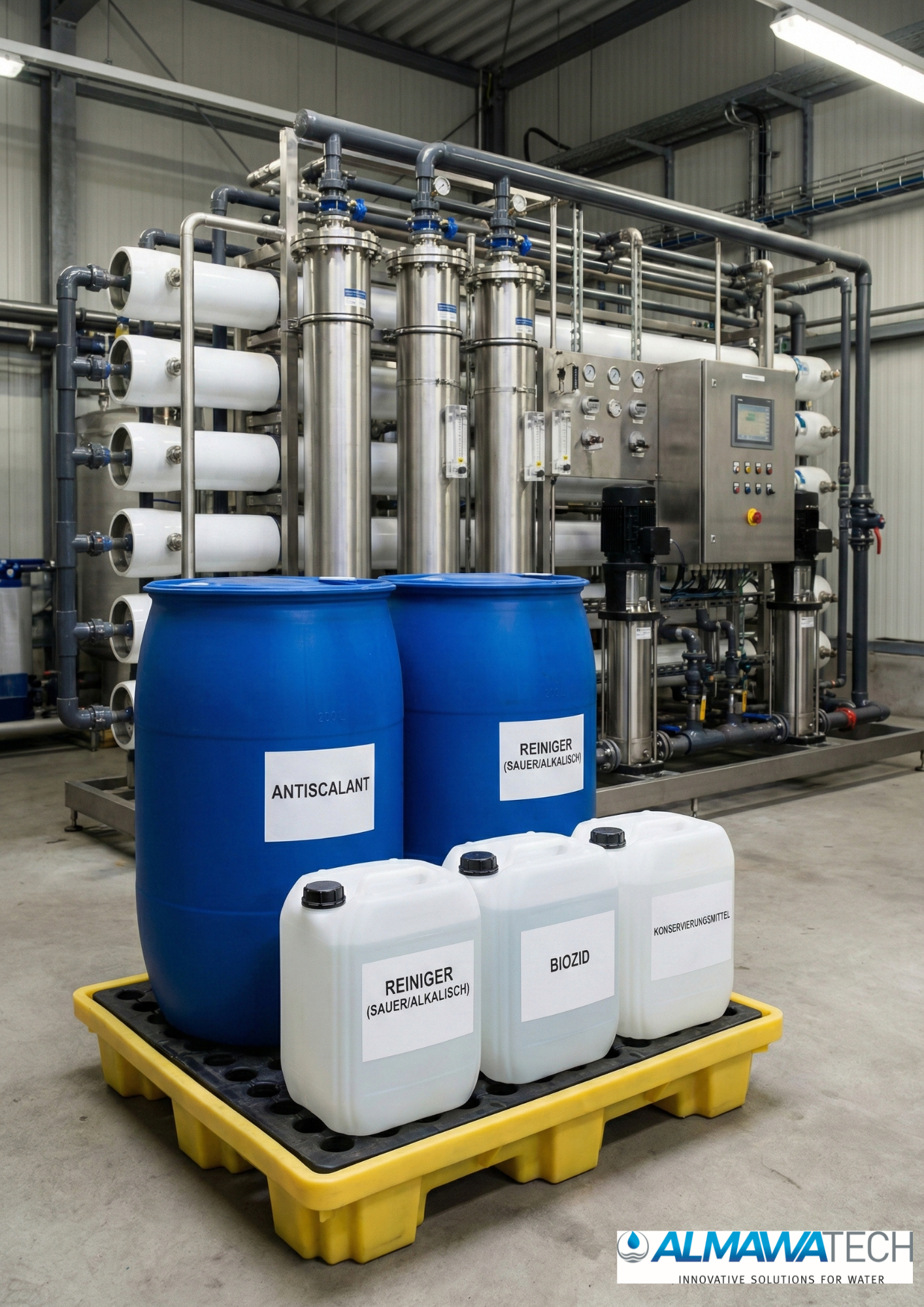
Membrane systems and reverse osmosis
We ensure the performance of your membrane systems, from antiscalant to cleaning!
Frank Kuntze
Sales Manager Water and Process Additives
Our solutions for membrane systems and reverse osmosis:
Proof of Performance - Our references






Your advantages with ALMA AQUA
Formulations & compatibility
Process additives & service - everything from a single source
Advice & system recording
Target definition
Product recommendation & treatment concept
Dosing and monitoring concept
Sampling & detection
Evaluation & reporting
FAQ
Why is the use of antiscalants so important in membrane systems?
Membrane systems such as reverse osmosis (RO), nanofiltration (NF), or ultrafiltration (UF) operate with high retention rates. This results in a high concentration of hardness minerals, sulfates, silicates, and other salts in the concentrate stream. Without suitable countermeasures, scaling deposits form on the membrane surface. These deposits block the pores, increase the differential pressure, and reduce the permeate throughput.
The consequences of uncontrolled scaling are:
Increased energy consumption due to higher delivery pressures
Decreasing salt retention and fluctuating permeate quality
Increasing cleaning effort up to irreversible membrane damage
Reduced service life of membrane elements and higher OPEX
Antiscalants prevent these effects by disrupting crystal growth, blocking crystal nuclei, and delaying or completely preventing the precipitation of hardness salts. The result is stable operation with:
higher recovery rates (yield),
extended cleaning intervals,
consistent water quality,
significantly longer membrane service life.
A precisely adjusted antiscalant program is therefore not only technical protection, but also a key lever for cost optimization and increased efficiency in membrane operation.
How do biofouling and organic deposits form in membrane systems—and how can they be prevented?
In addition to scaling, biofouling is one of the main causes of performance losses. Microorganisms accumulate on the membrane surfaces, forming biofilms and leading to a gradual, often difficult-to-detect drop in performance. These layers increase pressure losses, reduce water flow, and serve as a breeding ground for pathogenic germs.
Organic substances (e.g., humic substances), iron/manganese compounds, or silicates can also form deposits that block the membrane pores and stress the material structure.
Measures against biofouling and organic deposits:
Controlled pretreatment (filtration, softening, deferrization, activated carbon filter) to reduce the load in the inlet
Biocide programs with oxidative or non-oxidative active ingredients, tailored to membrane materials and approvals
Dispersers that break up biofilms and facilitate the transport of organic particles
Regular CIP cleaning (alkaline/enzymatic) to remove organic layers
Monitoring through microbiological tests (e.g., HPC, ATP, qPCR), pressure difference and permeate flow measurements
Only a combination of preventive measures, adapted biocide strategies, and targeted cleaning can prevent biofilms and organic deposits from compromising the economic efficiency of the membrane system.
What role does chemical cleaning (CIP) play in membrane systems?
Even with optimal dosing of antiscalants and biocides, deposits cannot be completely avoided. That is why cleaning-in-place (CIP) is a mandatory part of every membrane system. It is not initiated at fixed intervals, but according to defined operating parameters:
Permeate output drops by 10–15% compared to the initial value
Differential pressure increases across the diaphragm stages
Salt retention decreases and permeate quality deteriorates
Types of cleaning agents:
Acid cleaners: Remove limescale, sulfate, and metal deposits (calcium, barium, iron, manganese)
Alkaline cleaners: Remove organic deposits, biofilms, oils, and fats
Special cleaners: Dissolve silicate deposits or mixed coatings
A CIP process consists of rinsing, circulating with appropriate chemicals and temperature, exposure times, and final rinsing. It is crucial that the cleaning agents are compatible with the membrane material, as free chlorine compounds, for example, cause irreparable damage to many polyamide membranes.
A structured CIP concept ensures that the membranes regain their original performance and their service life is maximized.
How can the recovery rate of a reverse osmosis system be optimized without increasing the risk of scaling?
The recovery rate describes the ratio of permeate to feed water and is a decisive parameter for the economic efficiency of RO plants. A high recovery rate saves water, energy, and wastewater disposal costs. At the same time, however, as retention increases, so does the concentration of salts and hardness minerals in the concentrate stream—and with it the risk of scaling.
Optimization is achieved through a combination of process control and additive use:
Antiscalants: enable higher concentration factors by suppressing crystallization processes.
Online monitoring: Control of conductivity, pH, and pressure difference to detect critical conditions at an early stage.
Adjustment to raw water quality: The maximum permissible recovery value depends heavily on calcium, sulfate, silicate, iron, and barium.
Staging & hydraulics: Multi-stage system designs enable higher overall recovery while reducing the load on individual membrane stages.
Simulation tools: Software models (e.g., from membrane manufacturers) calculate the risk of scaling depending on water chemistry and recovery.
Only through these measures can the recovery rate be raised to economically optimal values (e.g., 75–85% in the industrial sector) without endangering the membranes.
What is the significance of the SDI (silt density index) for the operation of membrane systems?
The Silt Density Index (SDI) is the most important parameter for evaluating raw water quality upstream of a membrane system. It measures the tendency of water to clog filters or membranes with colloidal particles and fine suspended solids.
Typical limit values:
SDI ≤ 5: required for safe operation of RO systems
SDI 5–20: Pretreatment absolutely necessary (e.g., sand filter, ultrafiltration, coagulation/flocculation)
SDI > 20: direct use of RO membranes not possible
Significance in operation:
An excessively high SDI leads to fouling and increased pressure in the membrane.
It influences the frequency of CIP cleaning and thus the operating costs.
Regular SDI measurements are an integral part of operational monitoring and are often required by authorities or customers as proof.
ALMA AQUA ensures that membrane systems are operated with appropriate pretreatment (filtration, flocculation, UF) and continuous SDI monitoring. This minimizes fouling risks, reduces CIP frequency, and extends the service life of the membrane elements.
What is the difference between oxidative and non-oxidative biocides in membrane systems—and when should each be used?
Choosing the right biocide strategy is crucial for controlling biofouling in membrane systems in the long term. Since membranes—especially polyamide membranes—are sensitive to certain chemicals, their use must be carefully coordinated.
Oxidative biocides (e.g., sodium hypochlorite, chlorine dioxide, ozone):
Broad-spectrum and very fast-acting against bacteria, algae, and fungi.
Removes biofilms by oxidatively destroying cell structures.
Can only be used to a very limited extent with RO and NF membranes, as polyamide is irreversibly damaged by free chlorine or ozone.
Often suitable for pretreatment (e.g., in UF systems, cooling water pretreatment stages, or open storage tanks).
Non-oxidative biocides (e.g., isothiazolinones, quaternary ammonium compounds, glutaraldehyde):
Intervene specifically in the metabolism of microorganisms and destroy cell walls.
Membrane-compatible, as they do not cause oxidative decomposition.
Also effective in biofilms, but slower and often dependent on exposure time and concentration.
Typically used in the ongoing operation of RO and NF systems.
Practical strategy:
Combination of oxidative disinfection in raw water treatment and non-oxidative biocide use in ongoing membrane operation.
Supplemented by regular CIP cleaning to remove dead biomaterial.
Strict adherence to the manufacturer's specifications regarding dosing quantities, contact times, and rinsing cycles to prevent damage to the membrane.
With a coordinated biocide strategy, microbiological contamination can be controlled sustainably, pressure losses kept low, and membrane service life significantly extended.
How does ALMA AQUA use calculation tools to support the selection and dosing of the right antiscalant?
The correct selection and dosage of antiscalants determines whether a membrane system can be operated stably, efficiently, and over the long term. Standard solutions are often insufficient, as each water composition poses individual risks for scaling.
ALMA AQUA therefore relies on specialized calculation tools that make precise predictions about possible precipitation based on water analyses. Parameters such as calcium, magnesium, barium, strontium, silicate, iron, sulfate, and carbonate hardness are taken into account.
The calculation tool provides:
Predictions of supersaturation indices for various hardness constituents (e.g., Langelier, Stiff & Davis, or silicate indices).
Calculation of solubility limits for calcium carbonate, calcium sulfate, barium sulfate, strontium sulfate, and silicates.
Recommendations for the optimal antiscalant dosage in mg/L, tailored to the desired recovery rate.
Scenarios for different operating conditions (temperature, pressure, recovery) to also cover load changes and raw water fluctuations.
This simulation-based approach allows us to ensure that:
the right antiscalant is selected for the respective water chemistry,
the plant can be operated at maximum possible recovery,
Scaling is reliably prevented and cleaning intervals are extended.
This is how we combine scientifically sound calculations with practical operational reliability —and offer operators a customized solution for the efficient management of their membrane systems.
How is the cleaning strategy for a membrane system adapted to the respective type of deposit?
Membrane systems are subject to various stresses during operation. Deposits can be of mineral, organic, or biological origin—often in combination. An effective CIP (cleaning-in-place) strategy must therefore be precisely tailored to the type of deposits in order to remove them without damaging the membranes.
Typical types of deposits and how to clean them:
Mineral deposits (scaling): These include calcium carbonate, calcium sulfate, barium sulfate, strontium sulfate, and silicates. → Treatment with acidic cleaners (e.g., citric acid, phosphoric acid, or organic complexing agents) that dissolve the salts and restore the membrane surface.
Metallic deposits (iron, manganese, aluminum): Caused by corrosion products or inadequate pretreatment. → Removal using special complexing agents or reducing agents that dissolve the oxidation products.
Organic deposits: Humic substances, oils, fats, or surfactants can block membrane pores. → Clean with alkaline cleaners that contain surfactants and disperse organic substances.
Biofouling (microbiological deposits): Bacterial colonies and biofilms cause pressure losses and hygiene risks. → Removal using alkaline cleaners with enzymes or dispersants, followed by disinfection with non-oxidative biocides if necessary.
Strategic points in CIP planning:
Combination of cleaners: Often, alternating between acidic and alkaline cleaning is necessary to remove mixed deposits.
Sequence: As a rule, alkaline cleaning (against organic deposits and biofilms) is performed first, followed by acidic cleaning (against mineral deposits).
Operating parameters: Temperature, pH, and contact time must be strictly adhered to in order to achieve maximum effect with minimum membrane stress.
Monitoring: Performance monitoring via differential pressure, permeate flow, and salt retention—only when these parameters stabilize is the CIP considered successful.
With this deposit-dependent cleaning strategy, operators can ensure that deposits are removed in a targeted manner, the membranes are protected, and the original performance of the system is restored.
Need technical advice? Inquire now!
Frank Kuntze
Sales Manager Water and Process Additives