

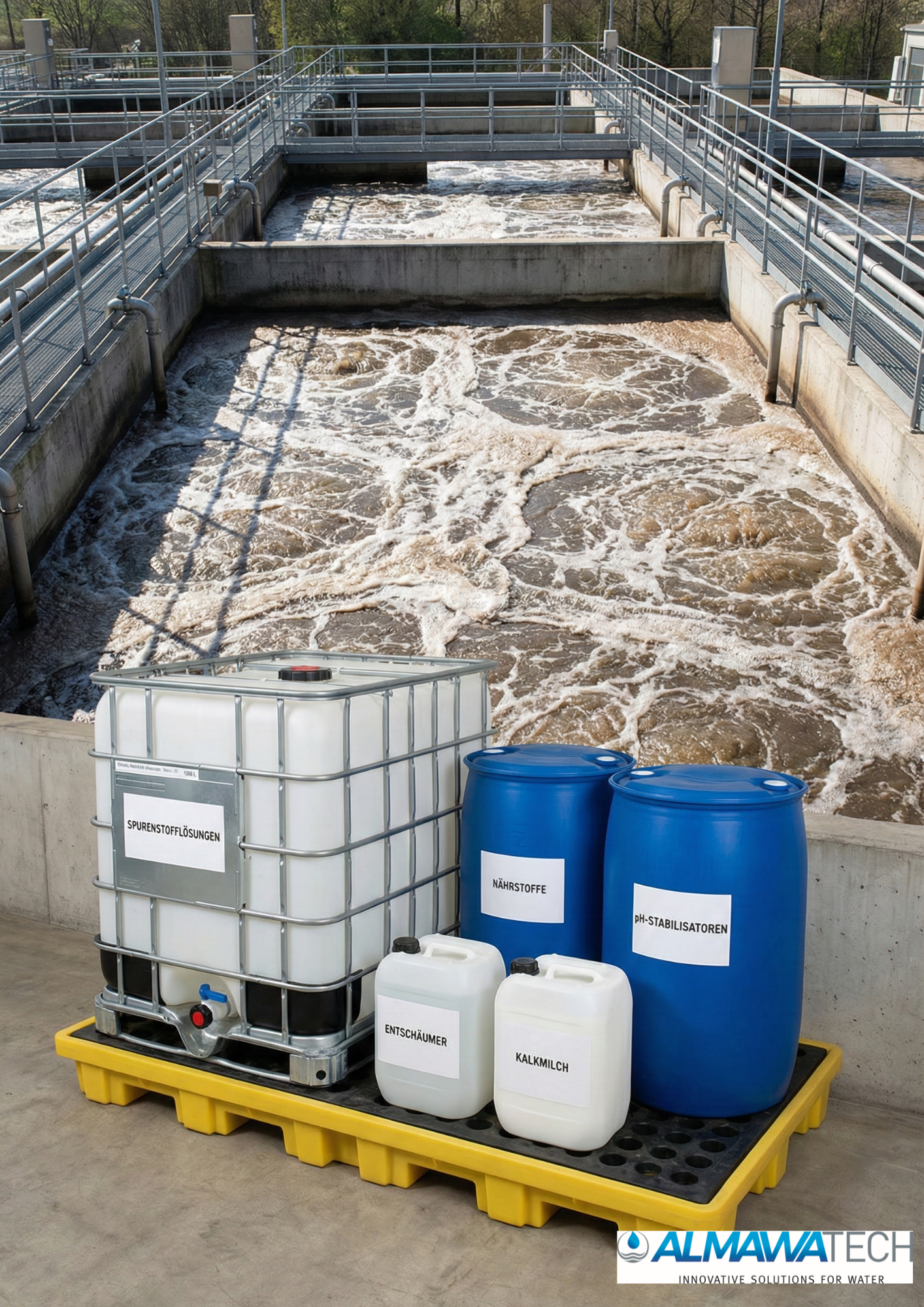
Reliably supporting biological processes
Contact our experts for individual advice on your biological water treatment system!

Frank Kuntze
Sales Manager Water and Process Additives
Objectives of biological wastewater treatment
Proof of Performance - Our references





Your advantages with ALMA AQUA
Standards and guidelines
Process additives & service - everything from a single source
Advice & system recording
Target definition
Product recommendation & treatment concept
Dosing and monitoring concept
Sampling & detection
Evaluation & reporting
FAQ
Why are trace elements so important in biological wastewater treatment?
In biological wastewater treatment processes, microorganisms take on the central task of breaking down organic and nitrogenous compounds. In order for these microorganisms to work efficiently, they require not only the main nutrients carbon (C), nitrogen (N) and phosphorus (P) but also a large number of trace elements. These include iron, copper, zinc, cobalt, nickel, molybdenum and manganese.
These trace elements act as cofactors of enzymes that are responsible for key metabolic functions:
Nitrification: Enzymes such as ammonium monooxygenase or nitrite oxidoreductase require copper, iron and nickel.
Denitrification: Molybdenum and iron, among others, are essential for the reduction of nitrate to gaseous nitrogen.
COD degradation: Many enzymes that break down organic carbon compounds are metal-dependent.
If these trace elements are missing or are not present in a bioavailable form, this leads to:
Decrease in biological activity,
unstable discharge values (e.g. increase in ammonium or COD),
increased sludge accumulation and disturbances such as filament growth,
In the worst case, this can lead to a biological process crash.
ALMA AQUA therefore develops customized trace substance solutions that are precisely tailored to the respective wastewater characteristics. In this way, deficits are eliminated and the biology works stably and efficiently.
How does ALMA AQUA develop individual trace substance solutions - and why is a standard dosage often not sufficient?
Industrial wastewater differs greatly in its composition. Dairy wastewater, for example, contains a lot of nitrogen but often too few trace elements. Wastewater from the paper industry, on the other hand, may be rich in organic carbon but lack important metals. Standard products cannot reflect these differences.
This is why ALMA AQUA is taking the path of individualization:
Process analysis: Detailed analysis of the inlet and outlet water as well as the biomass. The main nutrients, trace element content and possible inhibitors are determined.
Biological tests: measurement of respiration rates, nitrification performance, denitrification rate and microscopic sludge diagnostics.
Derivation of the requirement: Identification of limiting factors - e.g. iron deficiency in nitrifiers or cobalt deficiency in denitrifiers.
Formulation: Development of a precisely balanced trace substance solution that compensates for the deficits without risking overdosing or unfavorable side reactions.
Piloting: Testing of the recipe in operation and adaptation based on the results.
The result is a customized solution that guarantees the operator a stable biology, reliable discharge values and often lower operating costs.
What problems occur with an inadequate supply of nutrients or trace elements - and how can they be specifically avoided?
If the biology is not optimally supplied, this manifests itself in typical operating problems. These can be specifically avoided with trace substance and nutrient concepts.
Frequent malfunctions with deficiency:
Foam formation: Due to overgrowth of filamentous bacteria, which get out of hand if the nutrient supply is unbalanced.
Odor formation: Hydrogen sulphide (H₂S) is formed when denitrification stops and sulphate reducers dominate.
Unstable discharge values: Exceedances of ammonium, COD or nitrate due to lack of enzyme activity.
Excess sludge: Inefficient metabolism leads to more biomass with the same substrate decomposition.
Targeted countermeasures:
Regular process analysis for early detection of deficits.
Demand-oriented dosing of nitrogen, phosphorus and trace elements.
Individually developed trace substance solutions that are precisely tailored to the process.
Continuous monitoring of key parameters such as ammonium, nitrate, sludge index or oxygen consumption.
This prevents malfunctions in the long term and ensures stable operation - even under changing loads.
How can customized trace substance solutions help to reduce energy and operating costs in biological wastewater treatment?
Efficient biology requires less external energy and produces fewer by-products. The targeted supply of trace elements and nutrients therefore has a direct effect on operating costs:
Energy saving: Microorganisms with a complete supply of trace elements work more efficiently. They require less oxygen input for the same substrate decomposition - this reduces the aerator output, which usually causes the greatest energy consumption in wastewater treatment plants.
Reduced sludge consumption: Optimized metabolic pathways avoid excess biomass. Less excess sludge means lower disposal costs.
Stable processes: Fewer emergency measures, lower CIP/rinsing frequencies and no unplanned downtimes reduce OPEX.
Higher plant efficiency: A stable biological process reduces the need for downstream treatment and ensures that the effluent limits are permanently met.
The combination of process analysis and individually developed trace substance solutions means that biological wastewater treatment plants can not only be operated more stably, but also more economically and sustainably.
Which trace elements are particularly critical for nitrification - and how is a deficiency detected?
Nitrification - i.e. the conversion of ammonium (NH₄⁺) to nitrate (NO₃-) - is carried out by special bacteria (Nitrosomonas, Nitrobacter). These organisms are sensitive to trace element deficiencies because their key enzymes are metal-dependent.
Important trace elements for nitrification:
Copper (Cu): Component of ammonium monooxygenase.
Iron (Fe): Necessary for nitrite oxidoreductase.
Nickel (Ni): Essential for urease and hydrogenases, which often act in parallel.
Cobalt (Co) & molybdenum (Mo): Involved in denitrification and redox systems.
Signs of deficiency:
Increase in ammonium in the effluent despite adequate aeration.
Slow nitrite degradation (accumulation of NO₂-).
Higher oxygen consumption without corresponding degradation performance.
Microscopically: weak, unstable flake formation.
Targeted trace element dosing based on analyses ensures that nitrification remains stable even at high loads.
How can filament growth in biological wastewater treatment plants be controlled by targeted trace element supply?
Filamentous bacteria often occur when the biology is out of balance. Common causes are nutrient deficiencies, trace element deficiencies or unbalanced C:N:P ratios. Filaments lead to foam, bulking sludge and drainage problems.
Causes of filament growth:
Nitrogen or phosphorus deficiency in carbon-rich wastewater.
Lack of trace elements that limit the growth of the desired heterotrophic bacteria.
Unfavorable operational management (e.g. low sludge age, oxygen fluctuations).
Strategies for control:
Individually developed trace substance solutions that specifically promote the desired biomass.
Adjust the nutrient supply so that the C:N:P ratio (100:5:1) is maintained.
Stabilization of operational management (aeration, sludge age, return flow).
With the right trace element supply, operators can control the growth conditions in such a way that filaments are pushed back and stable flocs are promoted.
What role do trace elements play in anaerobic wastewater treatment - e.g. in biogas plants?
In anaerobic processes, bacteria and archaea convert organic material into methane and carbon dioxide. These consortia are highly sensitive to trace element deficiencies, as many of their key enzymes are metal-dependent.
Important trace elements in anaerobic bacteria:
Nickel (Ni): Component of methyl-coenzyme M reductase, key enzyme in methanogenesis.
Cobalt (Co): Important factor for vitamin B₁₂-dependent enzymes in propionate and acetate cleavage.
Molybdenum (Mo) & tungsten (W): Necessary for formate and hydrogenases.
Iron (Fe): Component of many redox enzymes.
Problems with shortages:
Increased propionate or acetate concentrations in the fermentation sludge.
Drop in methane production and increasing CO₂ content in biogas.
Acidity drop and unstable fermentation.
Biogas plants and anaerobic wastewater treatment plants can be operated in a stable, gas-rich and trouble-free manner with a targeted supply of trace elements, tailored to the feed and substrate composition. ALMA AQUA develops individual solutions for this based on a precise analysis of the substrates and fermentation conditions.
Need technical advice? Inquire now!
Frank Kuntze
Sales Manager Water and Process Additives