
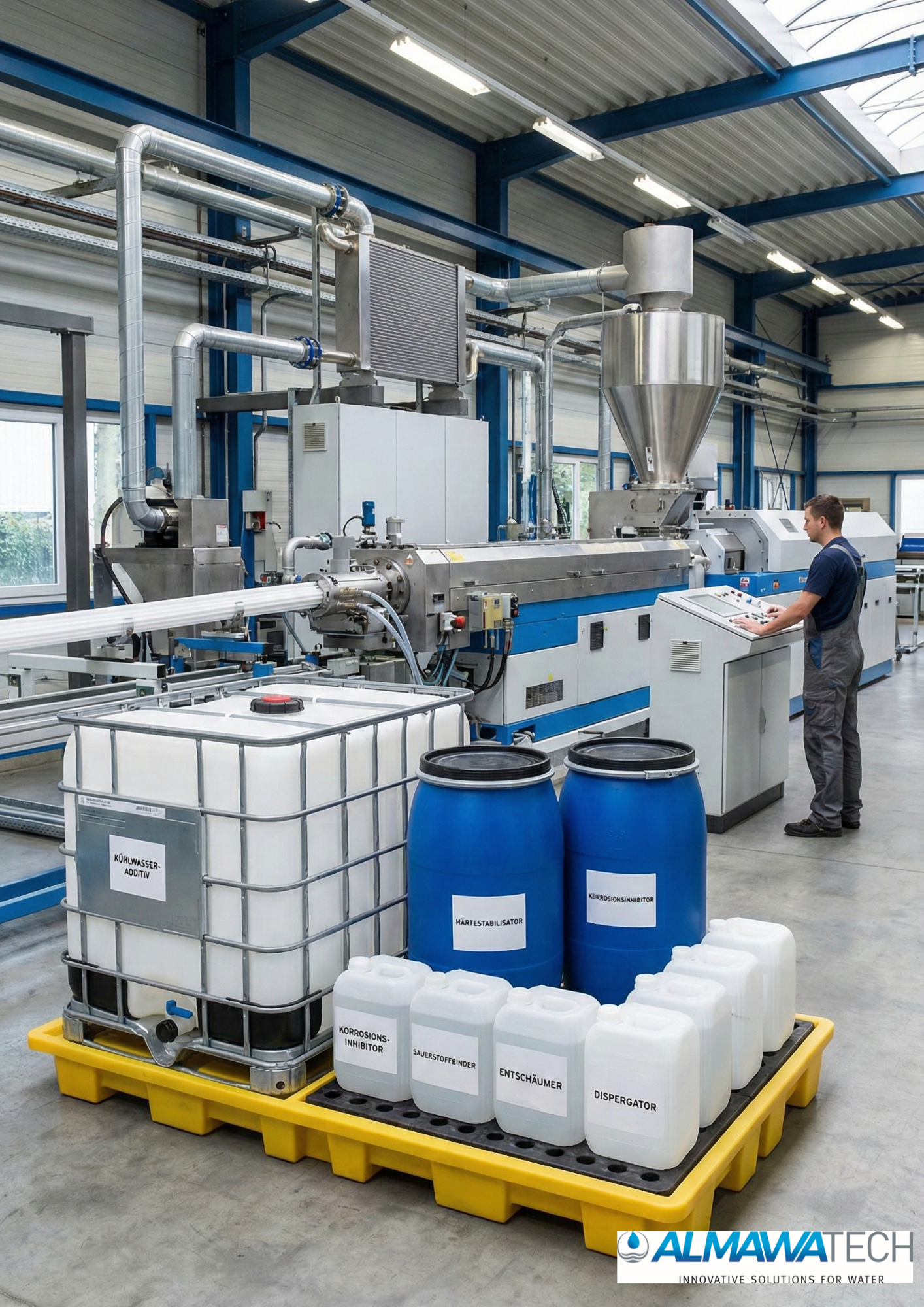
ALMA AQUA process additives
We ensure the operational safety of your water-bearing systems for the plastics industry & extrusion

Frank Kuntze
Sales Manager Water and Process Additives
ALMA AQUA solutions for the plastics industry & extrusion
ALMA AQUA boiler
ALMA AQUA Mem
ALMA AQUA cooling water
ALMA AQUA Waste water
Proof of Performance - Our references





Advantages for the plastics industry & extrusion
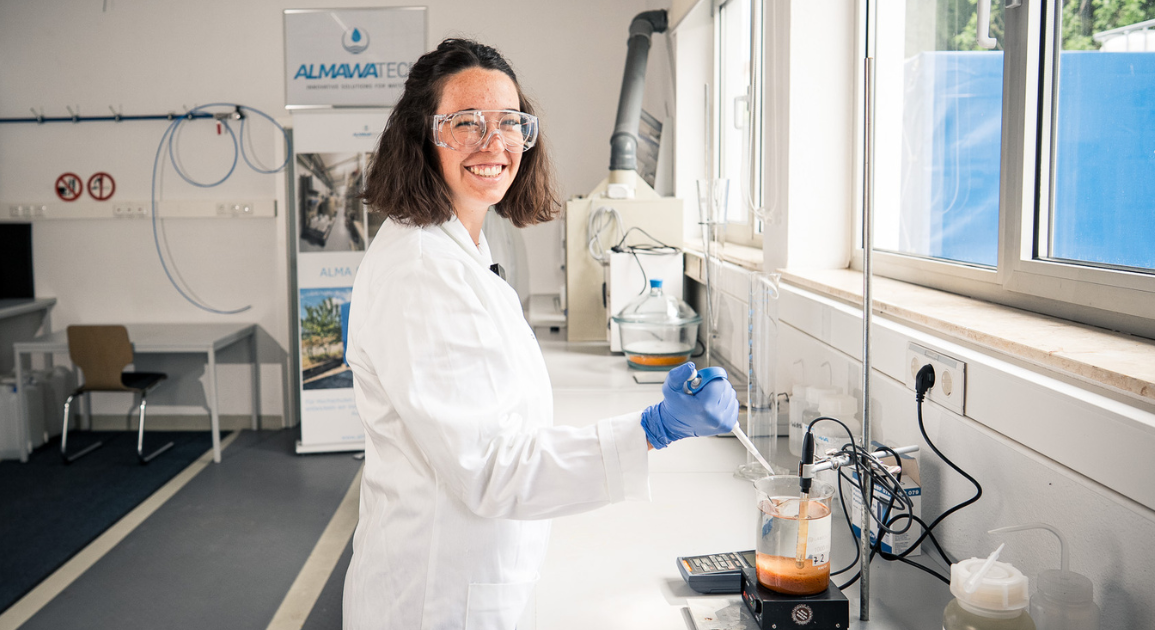
Service & technology - everything from a single source
Advice & system recording
Laboratory and practical tests
Online monitoring & software solutions
Integrated dosing and control technology
Automated additive replenishment
Evaluation & reporting
Formulations & compatibility
OEM & private label solutions
FAQ
How can deposits in cooling circuits and tools be avoided?
Why deposits are a major problem
In extrusion and injection molding, cooling water is used to quickly cool down tools and plastic parts. Even the smallest deposits of lime, iron or biofilms significantly reduce the cooling capacity. This results in longer cycle times, higher energy costs and quality problems such as uneven surfaces or dimensional deviations.
Additives against limescale, corrosion and biofouling
Hardness stabilizers prevent the crystallization of calcium carbonate and magnesium salts.
Dispersants keep corrosion products and fine particles in suspension so that they can be rinsed out.
Biocides inhibit microbial growth and stop the formation of biofilms in cooling ducts.
Defoamers prevent foam blankets in cooling tanks, which impair cooling performance.
Practical benefits for extrusion and injection molding
These additives keep tools, cooling channels and heat exchangers free of deposits. This means stable cycle times, consistent product quality and lower energy costs.
How can the operational safety of boiler and steam systems in the plastics industry be guaranteed?
Typical problems in boiler operation
Steam boilers are used in the plastics industry to heat extruders, drying systems or temperature control units. Without conditioning, there is a risk of scale, corrosion and unstable steam formation. Even a thin layer of limescale in the boiler can reduce efficiency by several percent and noticeably increase energy consumption.
Process additives for safe boiler operation
Oxygen binders such as sulphite or modern substitutes remove residual oxygen and prevent pitting corrosion.
Alkalizing agents (NaOH, phosphates) stabilize the pH value in the alkaline range and prevent CO₂-related acid corrosion.
Hardness stabilizers & deposit inhibitors prevent the formation of limescale and silicate deposits that block heat transfer.
Corrosion inhibitors & film formers create a stable protective layer on metal surfaces.
Defoamers ensure even steam formation and prevent foam cushions.
Practical benefits
Optimally conditioned boiler water ensures greater energy efficiency, a longer service life for the system and minimizes unplanned downtime in the production process.
How can wastewater from plastics recycling processes be treated efficiently?
The challenge of plastic washing water
Washing films, flakes or regrind produces highly contaminated wastewater containing surfactants, grease, dyes and organic residues. These significantly increase the COD values and make it difficult to comply with legal limits. Without pre-treatment, there is also a risk of problems in downstream biological stages or membrane systems.
Additives for efficient wastewater treatment
Precipitants convert dissolved substances into poorly soluble particles.
Flocculants & polymers form large, stable flocs and enable separation in lamella clarifiers, DAFs or filters.
pH regulators ensure the right environment for the precipitation and flocculation reactions.
Special additives such as de-emulsifiers break up oil/fat emulsions.
Practical benefits
Plastic wastewater streams are reliably stabilized with additives and can be treated economically. Operators benefit from safe compliance with limit values, lower chemical costs and reduced sludge volumes.
How can biofouling be prevented in closed cooling circuits?
Why biofouling is so dangerous
In closed cooling circuits, biofouling is caused by bacteria, fungi and algae that use organic material as a source of nutrients. Biofilms on pipes or heat exchangers lead to a drop in performance, increased energy requirements and corrosion damage.
Additives against biofouling
Biocides (oxidative & non-oxidative) control the growth of microorganisms.
Rotating biocide strategies prevent the development of resistance.
Dispersants stabilize biofilm residues that are removed in the water flow.
Defoamers prevent foaming in circuits, which is often associated with a high biological load.
Practical benefits
Clean cooling circuits ensure a high level of heat transfer, prevent energy losses and increase the service life of system components.
How can a stable process water cycle be established in extrusion?
The challenge of recirculation
Process water is recirculated in the extrusion of pipes, profiles and films. Without additives, it becomes contaminated by fillers, abrasion and microorganisms. This leads to deposits in cooling channels, odor development and fluctuating cooling performance, which impair product quality.
Additives for process water stability
Hardness stabilizers prevent the formation of limescale on cooling channels and tools.
Biocides keep the water hygienically stable and prevent odors.
pH regulators ensure stable conditions and corrosion protection.
Dispersants keep solids in suspension and prevent deposits.
Practical benefits
A stable process water circuit ensures constant cooling capacity, consistently high product quality and reduces chemical consumption through targeted dosing.
How can process additives be used to reduce wastewater treatment costs in plastics companies?
Why wastewater treatment is expensive
Wastewater from the plastics industry varies greatly - from washing water to cleaning wastewater with surfactants and additive residues. Without targeted treatment, high chemical costs, large volumes of sludge and high energy consumption arise.
Additives for cost-efficient wastewater treatment
Efficient precipitants produce compact, easily dewaterable sludge.
Polymers improve water separation in presses and centrifuges.
Oxidative additives break down stubborn organic residues.
Defoamers prevent process disruptions and increase system performance.
Practical benefits
Optimized additives reduce operating costs in wastewater treatment by up to 30 %, while at the same time ensuring compliance with limit values.
Need technical advice? Inquire now!
Frank Kuntze
Sales Manager Water and Process Additives